




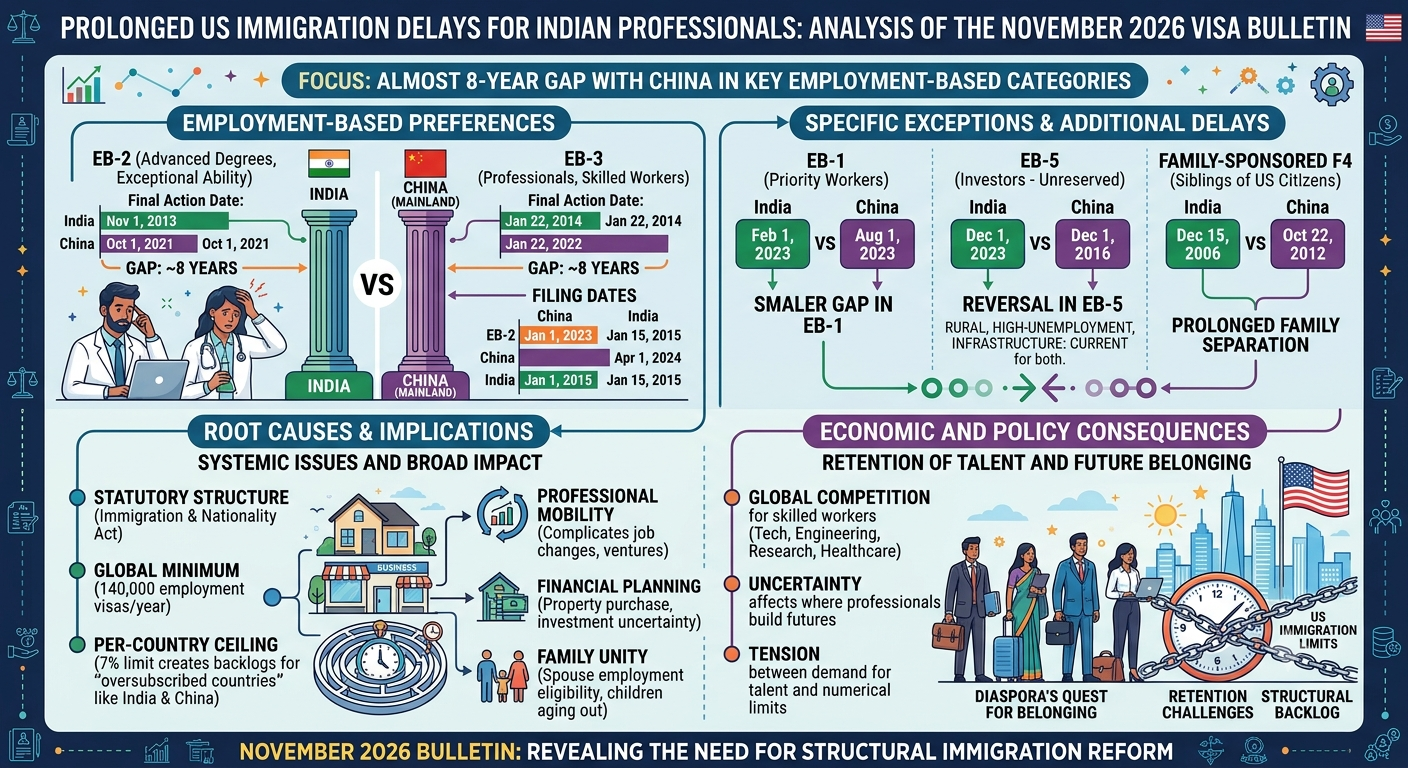
Indian professionals seeking permanent residency in the United States are facing a significant delay, with the November 2026 Visa Bulletin revealing an almost eight-year gap between Indian and Chinese applicants in key employment-based green card categories. This trend raises concerns about the disparities in access to permanent residency and its long-term implications for the Indian-American community and U.S. employers.
The bulletin issued by the U.S. Department of State highlights major differences in the employment-based second preference (EB-2) and third preference (EB-3) categories, which are commonly utilized by employer-sponsored professionals. For EB-2, India’s final action date is set at November 1, 2013, while Chinese applicants see a cutoff of October 1, 2021. In the EB-3 category, India’s cutoff is January 22, 2014, compared to January 22, 2022, for China. This disparity places Indian applicants approximately eight years behind their Chinese counterparts.
Moreover, filing dates reveal a similar trend. In EB-2, the filing date for Indian applicants is January 15, 2015, compared to January 1, 2023, for China. For EB-3, the filing date for China is April 1, 2024, versus January 15, 2015, for India. These figures illustrate the challenges faced by Indian professionals who have established careers in American industries yet remain in limbo without permanent residency.
The repercussions of these delays extend beyond immigration documentation. Prospective residents often encounter complications with job changes, entrepreneurship, property investments, and long-term financial planning. Family members also face uncertainty regarding employment eligibility and immigration status as they age into adulthood.
Despite these challenges, not all aspects are unfavorable for Indian applicants. In the employment-based first preference (EB-1) category, which includes priority workers, India’s final action date is February 1, 2023, compared to August 1, 2023, for Chinese applicants, indicating a smaller gap. Additionally, in the EB-5 category for investor visas, India’s date is December 1, 2023, while China’s is December 1, 2016.
The structural issues within U.S. immigration law contribute to this backlog. The Immigration and Nationality Act mandates a worldwide minimum of 140,000 employment-based visas per year, with a per-country cap of 7% of the total limit. As a result, India and mainland China remain among the oversubscribed nations, leading to prolonged wait times for applicants even after their employment petitions have been approved.
In family-sponsored immigration, Indian applicants also face extensive delays. The final action date for the fourth preference (F4), which covers siblings of adult U.S. citizens, is December 15, 2006, for India, compared to October 22, 2012, for China. These delays contribute to prolonged family separations across generations.
The November Visa Bulletin does not propose solutions to the existing visa backlog, highlighting the conflict between the U.S. demand for skilled global talent and an immigration system limited by numeric caps and country-specific allocation rules. For the Indian-American community, navigating the green card queue has become more than a bureaucratic hurdle; it poses challenges related to professional growth, family security, and the aspiration for permanent residency in the U.S.
