




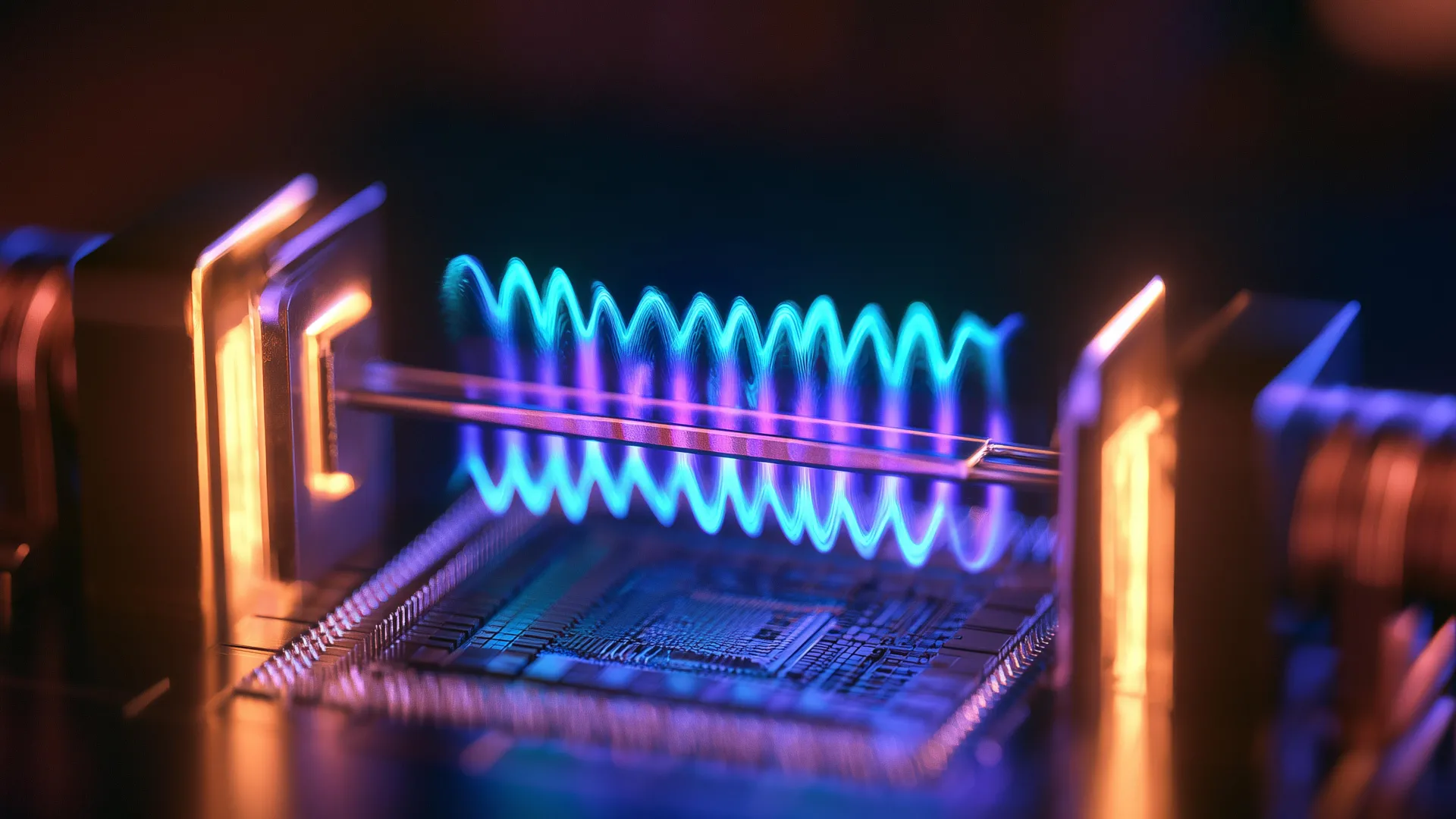
A team of researchers at ETH Zurich has discovered a novel way to utilize microscopic mechanical vibrations for storing and manipulating quantum information, akin to the way guitar strings produce musical notes. Physicist Yiwen Chu leads this groundbreaking work, which represents a significant advancement in quantum computing technology.
The vibrations utilized in this new system occur at frequencies beyond human hearing and take place within a miniature quantum chip, serving as a fresh approach to computer memory. By harnessing these vibrations, the researchers have established a method that allows quantum computers to process information more efficiently while providing a flexible working memory. “The interaction between the quantum processor and the quantum memory provides a crucial foundation with a view to establishing quantum computers as a powerful and reliable way to perform computations that are not feasible with conventional computers,” said Chu.
The findings were published in the journal Science, outlining a design that distinguishes the roles of information processing and storage. Instead of tightly integrating these functions, which is common in many existing quantum systems, Chu’s architecture allocates them more separately.
Adapting Conventional Computer Principles
In developing their quantum system, the researchers drew inspiration from traditional digital computers. In standard computing, the central processing unit (CPU) performs calculations while a separate area, known as random access memory (RAM), stores information. Chu’s quantum design mirrors this principle closely; a superconducting qubit serves as the processor while a separate quantum memory holds information temporarily.
Unlike conventional systems that utilize electromagnetic methods for information storage, Chu’s team employs mechanical vibrations for their quantum memory. “In our quantum working memory, however, information is not stored electromagnetically — as is usually the case today — but rather in the form of mechanical vibrations,” Chu explained.
Quantum computers leverage the unique aspects of quantum physics, including superposition and entanglement, to potentially solve certain intricate problems more quickly than traditional computers, including calculations currently beyond their physical limits.
Maintaining precise control over quantum information poses a significant challenge, as small disturbances can lead to data loss. The new system employs mechanical resonators that hold information in distinct vibration patterns. When the superconducting qubit requires this information, it retrieves the relevant vibrational state, carries out the necessary operation, and then returns the modified data to memory.
Current quantum computers typically rely on electromagnetic memory alongside superconducting qubits, which although well-understood, take up considerable space and may hinder the development of larger, more powerful systems. In contrast, mechanical resonators are more compact and capable of storing multiple vibration patterns simultaneously, allowing for greater information storage.
Research from Chu’s team demonstrates the practical ability of mechanical resonators to work alongside superconducting qubits in performing quantum calculations. They tested two critical computational techniques: the quantum Fourier transform and period finding, both essential for precise quantum computing. “The Quantum Fourier Transform is a fundamental computational procedure required for many quantum algorithms,” noted Igor Kladaric, a doctoral student and co-author of the publication.
The success of these experiments confirms that the proposed architecture can support actual quantum computation and not merely function as a storage device. The research indicates that the system could potentially execute all fundamental operations necessary for a programmable, general-purpose quantum computer.
Despite these promising developments, the next challenge is scaling this technology for larger systems without compromising precision and reliability. Chu and her colleagues are investigating further enhancements to their approach, with the goal of determining how well mechanical quantum memory can endure as more components and complex computations are incorporated.
While fully functional quantum computers remain a future prospect, the advancements at ETH Zurich mark a significant step toward the creation of machines capable of widespread scientific and industrial applications.
