




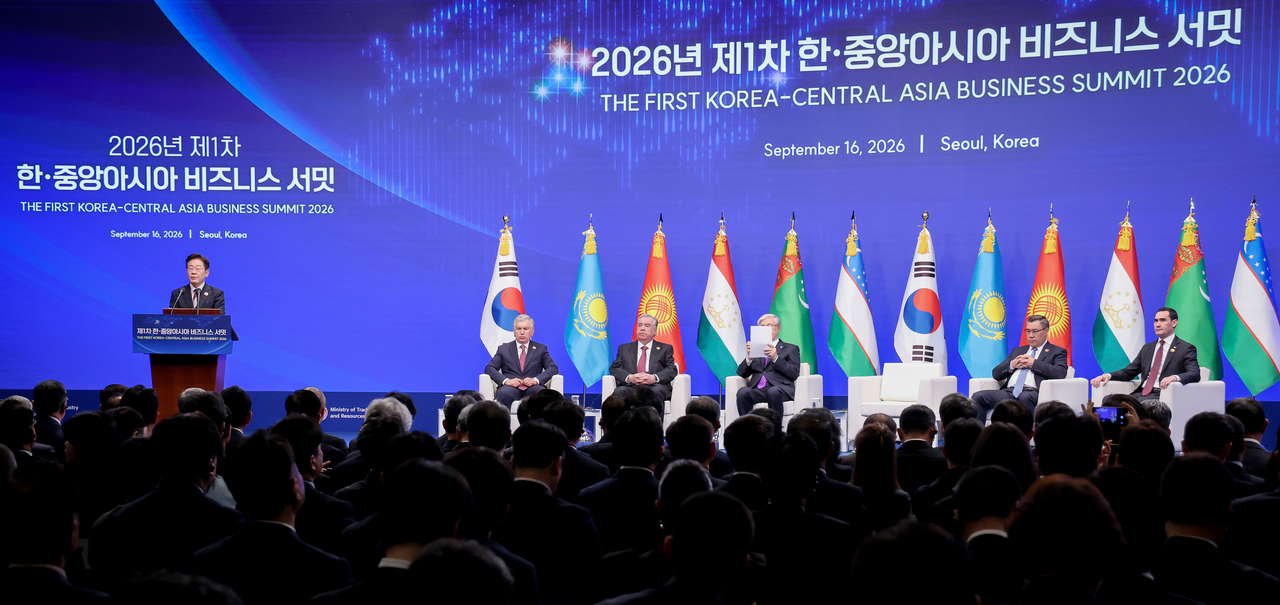
President Lee Jae Myung of South Korea has called for enhanced collaboration with five Central Asian nations to create a “new Silk Road,” focusing on a comprehensive economic partnership that encompasses trade, industry, and infrastructure development. Lee made this appeal during the Korea-Central Asia Business Summit held in Seoul.
Strengthening Economic Ties
In his address at the summit, President Lee emphasized the historical significance of the Silk Road, which has facilitated exchanges between Korea and Central Asia for over a thousand years. He expressed a desire to elevate this relationship into a new phase of cooperation. This business summit followed the inaugural Korea-Central Asia summit, which resulted in the adoption of the Seoul Declaration, outlining a framework for long-term regional cooperation.
Leaders from Kazakhstan, Kyrgyzstan, Tajikistan, Turkmenistan, and Uzbekistan were present at the summit. Lee noted that the ancient Silk Road should inspire efforts to cultivate deeper ties in trade, especially in critical minerals and infrastructure. “If we walk together, I am certain that the road of 1,500 years ago will reopen as a new and beautiful Silk Road,” he said. Lee highlighted the importance of collective wisdom in overcoming current challenges faced by the nations involved.
Lee’s proposal is structured around three main areas: expanding trade and investment, developing a framework for cooperation in critical minerals and advanced manufacturing, and enhancing infrastructure development. He remarked that the goal is to move beyond traditional trade, currently centered on Korean exports of automobiles and Central Asian exports of energy and raw materials.
To facilitate this expansion, Lee announced plans for the South Korean government to send trade delegations to Central Asia and establish “Korea Desks” in each of the five nations. These desks would serve as resources for Korean businesses operating in the region, helping address challenges and improve access to markets.
In discussing critical minerals, Lee highlighted Central Asia’s potential as a supply hub, particularly for materials essential for electric vehicles, batteries, and semiconductor production. He proposed a comprehensive partnership encompassing exploration, refining, and manufacturing of materials, aiming to foster full-cycle cooperation that benefits both regions.
Regarding infrastructure, Lee pointed out that Central Asia has a population of around 84 million, with a young demographic and a growing economy. He affirmed South Korea’s commitment to being a reliable partner in developing the region’s infrastructure, including urban projects, railways, and energy networks. “We should work together to build transport and energy arteries across this vast continent,” he asserted.
Why It Matters
President Lee’s appeal for a new Silk Road represents a significant step towards deepening economic relations between South Korea and Central Asia. This initiative has the potential to boost trade, improve infrastructure, and enhance regional stability, offering mutual benefits amid evolving global supply chains and economic landscapes.
