




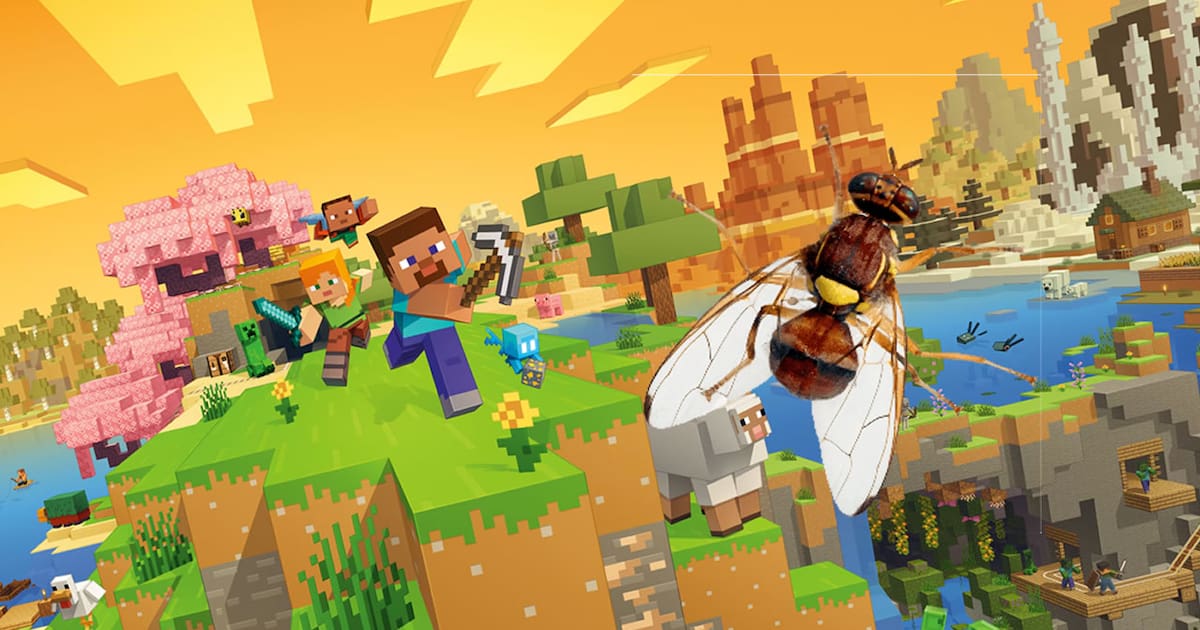
In a remarkable intersection of science and technology, a YouTuber has successfully transplanted the brain of a fruit fly into the popular video game Minecraft. This unprecedented experiment aims to explore the insect’s responses and test its simulated consciousness within a gaming environment.
A Fly’s Brain Ended Up Inside Minecraft Thanks to an Unusual Scientific Experiment
The experiment, conducted by a YouTuber known as Roooney, builds upon previous research conducted by Dr. Arie Matsliah, a research scientist at Princeton University. Dr. Matsliah’s work has focused on mapping the connections within a fruit fly’s brain, revealing a vast network of 54.5 million synapses. This data has been transformed into a tool that can be used for programming simulations.
Rather than transplanting a physical brain, the experiment utilized mathematical data to represent the neural connections. This approach simplifies complex biological processes while allowing for the emulation of a brain’s functions in a virtual setting.
Roooney’s project involves programming within Minecraft, enabling the virtual insect to react to various stimuli. By granting it the ability to experience fear, the experiment sought to model one of the fundamental sensations associated with consciousness and survival.
The Minecraft Fly Responds to Hunger, Though As We Know It in Nature
Further experiments conducted by Roooney delved into the simulation of hunger, assessing how the Minecraft insect responded to food shortages. The virtual fly demonstrated a recognition of energy depletion and indicated a need to replenish its resources within the game.
Although the response mechanism is comparatively simplified compared to biological processes in actual organisms, this experiment illustrates a brain-like reaction to environmental stimuli, showcasing the potential for programming to mimic certain aspects of cognition and logic.
This innovative application of gaming technology and scientific research opens new pathways for understanding consciousness and can potentially influence both educational and research methodologies in biology and neuroscience.
Why It Matters
This experiment exemplifies how video games can serve as more than entertainment, providing a platform for scientific exploration and modeling complex biological functions. As technology continues to evolve, projects like these could enhance our understanding of animal behavior and the underlying neural processes, bridging the gap between digital platforms and real-world science.
