




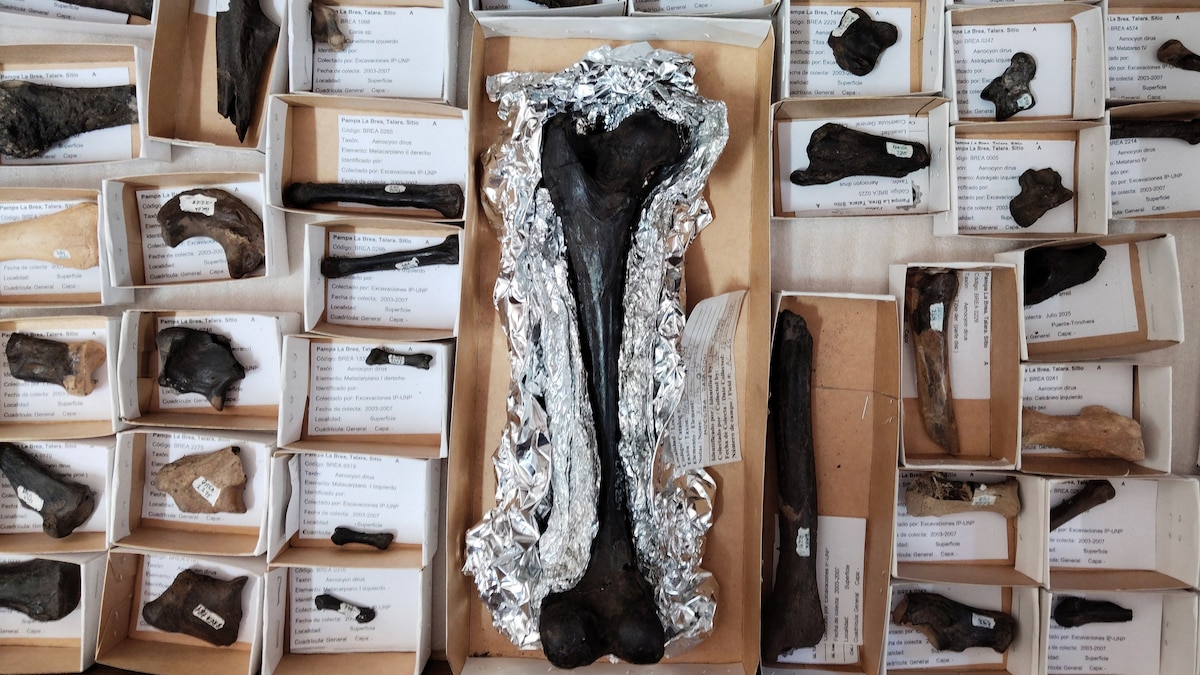
Researchers in northwestern Peru have uncovered a significant trove of fossils from the Late Pleistocene era within a newly identified tar pit near the city of Talara. The excavation has revealed approximately 300 fossils, although experts estimate the pit holds a total of tens of thousands of bones, providing a unique glimpse into ancient ecosystems.
During a summer expedition led by Emily Lindsey, a paleontologist at the La Brea Tar Pits in Los Angeles, and Jean-Noël Martinez from the Institute of Paleontology at the National University of Piura, the team utilized small chisels and dental tools to carefully extract the fossils. Larger specimens, such as a giant ground sloth’s jaw and the femur of a dire wolf, were encased in foil and protected with plaster casts, while smaller bones were wrapped in toilet paper for safe transport back to the laboratory.
This excavation highlights that the area, once a vibrant marshland, underwent significant ecological shifts due to receding glaciers that altered South America’s climate. “Talara provides a rich record of how the end of the Ice Age played out in the tropics,” said Lindsey.
Martinez emphasized the importance of these findings, claiming they document a far more complex story than previously understood. “These fossils provide more than a single snapshot in time; they show that there is a much larger story to be told at Talara,” he stated.
The fossil record at Talara indicates a diverse range of fauna, including newly identified species of rodents and bats. Moreover, the vertebrae of a tree-dwelling snake suggest that forests may have existed in the region during the Pleistocene.
Historical context regarding the site shows that Talara has been of interest since the 1950s when workers first unearthed notable bones during asphalt collection. The original excavation in 1958 yielded over 28,000 fossils, including many large carnivores like saber-toothed cats, providing insight into the prehistoric ecosystem that existed in the region.
Follow-up work has allowed researchers to revisit and study the smaller fossils that sat untouched for decades. In fact, recent research affirmed the existence of at least 90 different species of birds, signifying a complex and diverse ancient environment.
The ongoing study of fossils from Talara seeks to enhance understanding of how species adapted to environmental changes during a crucial period of climate transition, as many animals either migrated or faced extinction in response to a drying landscape. “Only two of the 21 identified songbird species from the fossils still inhabit the area today,” noted the researchers.
As part of a commitment to scientific integrity and local collaboration, the fossils extracted from this recent excavation will remain in Peru for continued research. “We now want to make these specimens accessible to local researchers and build scientific collections in the country of origin,” said Kevin Seymour, an assistant curator who participated in the expedition.
The next phase of research by Lindsey and her team involves uncovering more of the blackened bones hidden within the tar pits. Martinez remains optimistic, stating, “As a paleontologist, I know that is never true—we can always find more discoveries waiting to be uncovered.”
The fascinating insights derived from these excavations at Talara not only shed light on the prehistoric life that once thrived there, but also reflect the dynamic relationship between ancient ecosystems and their changing environments.
