




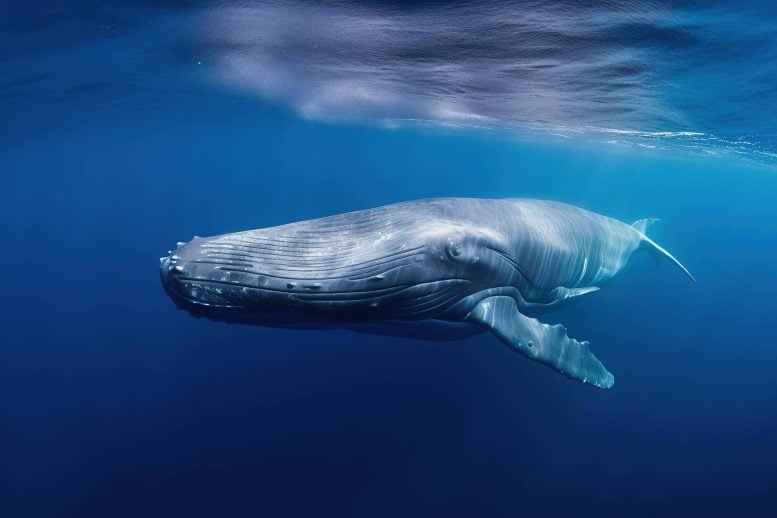
Research conducted on eastern Australian humpback whales has revealed that these marine giants grow faster than previously thought. The study, led by Griffith University, involved 865 individually identified whales and found that by the age of five, they reach approximately 10.9 meters (35.8 feet) in length. By six or seven years old, they achieve around 90 percent of their final adult body length.
The results, published in Marine Mammal Science, indicate that the growth rate of eastern Australian humpback whales surpasses that of other studied populations. Lead researcher Stephanie Stack, a PhD candidate at Griffith University, stated, “This is faster growth than other humpback whale populations that have been measured.”
Drone Technology Aids Research
To gain insights into the growth patterns of these whales, researchers utilized drones to photograph the animals from above, enabling them to measure body lengths without disturbing the whales. This aerial approach was conducted between 2021 and 2024 and involved tracking growth from newborn calves to adults over 40 years old.
The measurements demonstrated rapid growth in the early life stages of the whales, which then slows as they approach their adult size. Including younger whales in the study offered direct insights into development rather than relying solely on historical data from older individuals.
Stack noted that this research marks the first time contemporary growth curves for eastern Australian humpback whales are based on measurements from live animals. This contrasts with older data, which primarily relied on records from the commercial whaling era of the mid-20th century.
Since the cessation of commercial whaling, the eastern Australian humpback population has seen substantial recovery and is viewed as a success story in whale conservation efforts. Despite significant environmental changes, the new growth measurements align closely with historical estimates for adult sizes.
“These new growth curves establish a baseline for investigating how whale biology may respond to changing environmental conditions,” Stack explained, emphasizing the importance of understanding whale growth as it relates to health, energy requirements, and reproduction timing.
The findings provide a critical reference for future research into how whale growth and development may be impacted by ongoing oceanic changes. Stack added, “As environmental conditions continue to change, having robust biological benchmarks like these will be essential for understanding how whale populations are responding.”
This study highlights the evolving understanding of humpback whale biology and underscores the value of modern research techniques in marine science.
