




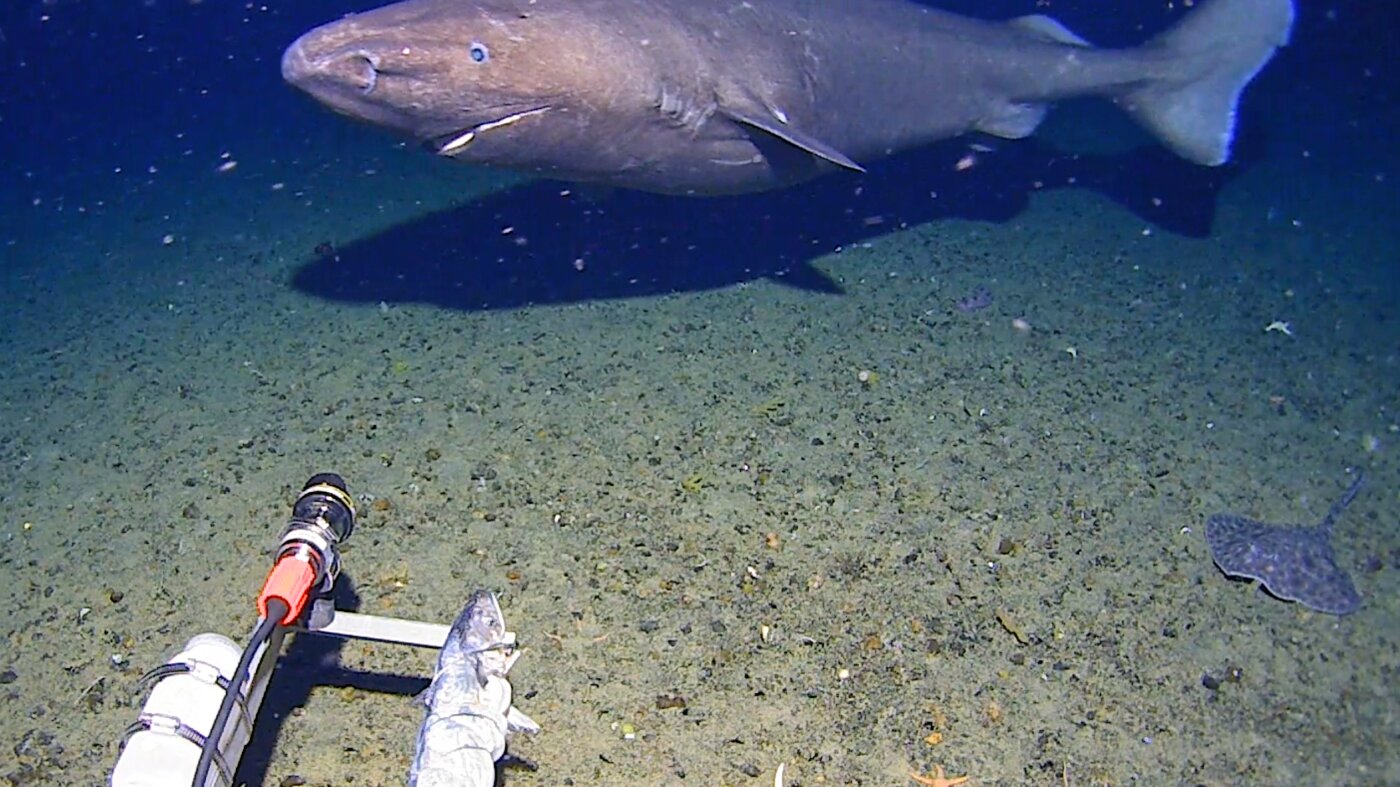
MELBOURNE, Australia — A sleeper shark has been captured on video for the first time in the frigid depths of the Antarctic Ocean. This sighting challenges previous assumptions about shark populations in such extreme environments, where many experts believed sharks could not survive.
First Recorded Sighting of a Shark in Antarctic Waters
The shark was filmed in January 2025 by the Minderoo-UWA Deep-Sea Research Centre, which focuses on studying life in the ocean’s deepest regions. The footage shows a substantial specimen, estimated to be between 3 and 4 meters (10 to 13 feet) long, swimming over a barren seabed at a depth of 490 meters (1,608 feet), where the water temperature was recorded at 1.27 degrees Celsius (34.29 degrees Fahrenheit).
According to researcher Alan Jamieson, this discovery is significant because it overturns a long-held belief that sharks do not inhabit Antarctic waters. “We went down there not expecting to see sharks because there’s a general rule of thumb that you don’t get sharks in Antarctica,” he stated. The footage captured a unique moment as the shark moved cautiously into the beam of the camera.
Peter Kyne, a conservation biologist at Charles Darwin University, noted that there has never been a documented shark sighting so far south. While the presence of other marine species, such as skates, has been established in these waters, the rarity of shark sightings suggests that their populations may be sparse and difficult to detect.
The research center released the footage on Wednesday, highlighting the unexpected nature of this sighting. Jamieson explained that the Antarctic Ocean’s complex stratification could be a factor in the elusive nature of sleeper sharks. The layering system of the ocean prevents easy mixing of water, potentially influencing the distribution of marine life.
This finding raises questions about the potential impact of climate change on marine ecosystems. As Antarctic waters warm, sharks may be extending their range into previously inhospitable areas. However, Jamieson emphasized the lack of research at such depths and the challenges posed by the remoteness of the region.
Jamieson anticipates that other species of sharks may inhabit similar depths, scavenging on organic matter that sinks from the surface, including the remains of larger marine animals.
With limited opportunities for observation in the Antarctic regions, especially outside the summer months, this encounter underscores the surprises that remain in ocean exploration.
Why It Matters
This discovery not only expands the known range of shark species but also invites further investigation into the effects of climate change on marine biodiversity in one of the most isolated parts of the world.
