




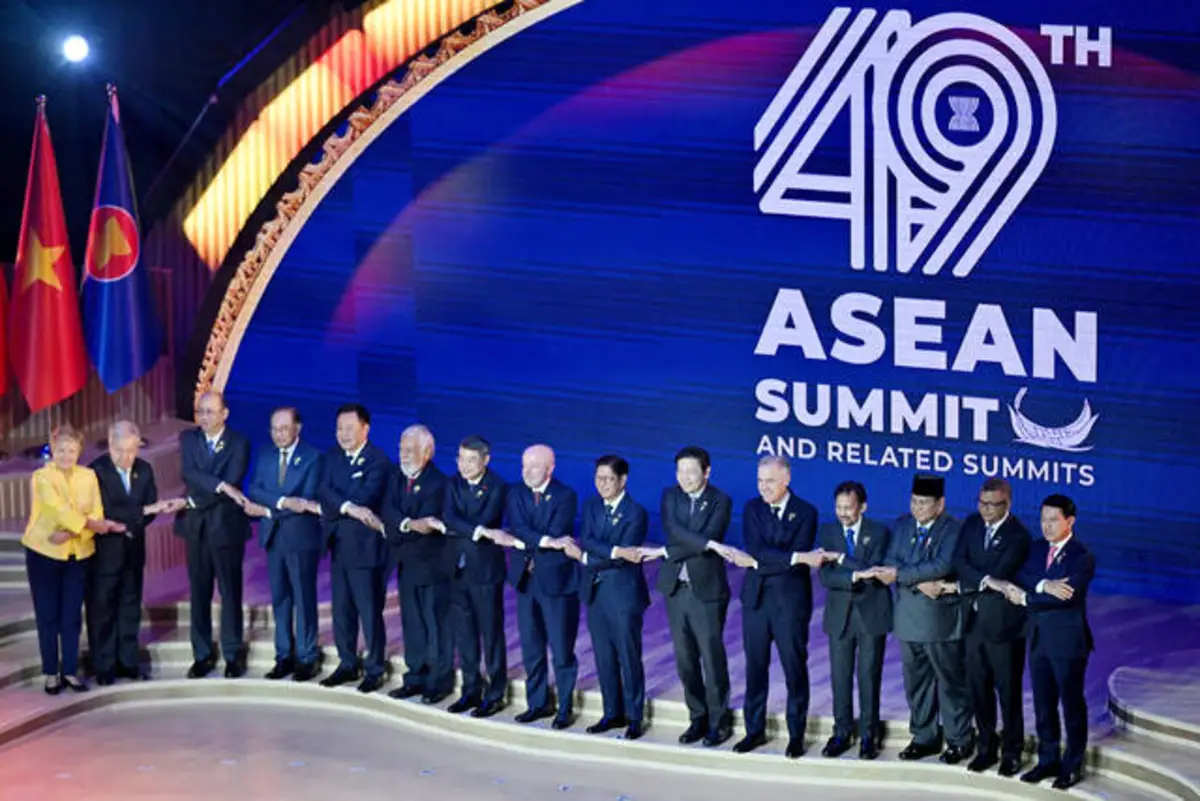
MANILA, Philippines — Southeast Asian leaders convened in the Philippine capital on Sunday for a three-day summit, where discussions will include the participation of global leaders, including U.S. President Donald Trump. His visit to Asia comes after his party’s loss in the midterm elections, which may impact his standing among allies.
Leaders from the Association of Southeast Asian Nations (ASEAN) are set to address significant global issues, particularly conflicts surrounding the Middle East, as detailed in drafts of upcoming communiques obtained by The Associated Press. The discussions aim to establish a collective response to pressing geopolitical tensions and economic challenges.
Trump, accompanied by U.S. Secretary of State Marco Rubio, is expected to arrive in Manila on Tuesday afternoon following the completion of the main ASEAN meetings. Philippine President Ferdinand Marcos Jr. will then pass the rotating chairmanship of the regional bloc to Singapore.
In their talks, ASEAN leaders are anticipated to emphasize self-restraint and the pursuit of peaceful resolutions to ongoing disputes, including those in the South China Sea and Myanmar’s civil conflict. They aim to address the economic repercussions of these conflicts affecting the region.
The draft statement from the summit reaffirms commitment to international law and highlights the importance of peaceful dispute resolution and the freedom of navigation. “We reaffirmed our shared commitment to upholding international law, including the United Nations Charter,” the statement notes.
Marcos stressed the need for unity within ASEAN amid diverse political systems and external pressures. “That commitment matters even more as the waters around us turn on shifting tides, geopolitical tensions, economic uncertainty, new technologies, climate change, and transnational threats,” he said in an opening address at a convention center secured by heavy security near Manila Bay.
Despite the bloc’s intentions, achieving cohesion remains challenging, given its mix of democratic and authoritarian states—many of which have varying degrees of alignment with either the U.S. or China.
Trump’s visit will include participation in key meetings, including one with the Quadrilateral Security Dialogue, involving the U.S., Japan, Australia, and India—a forum often viewed as a counterbalance to Chinese influence. Following these discussions, Trump is scheduled for a state luncheon with Marcos before both leaders travel to Shenzhen, China, for the APEC summit hosted by President Xi Jinping.
American geopolitical analyst Greg Poling commented that Trump’s brief stop in Manila aims to reassure allies amid concerns stemming from the recent midterm electoral setbacks. He also noted that expectations for substantial progress in U.S.-China relations may be muted, attributing a lack of compromise from the Chinese side to Trump’s political vulnerabilities.
China will be represented at the summit by Premier Li Qiang, who will engage with ASEAN leaders on Monday but is expected to depart prior to Trump’s arrival, according to Philippine officials.
