




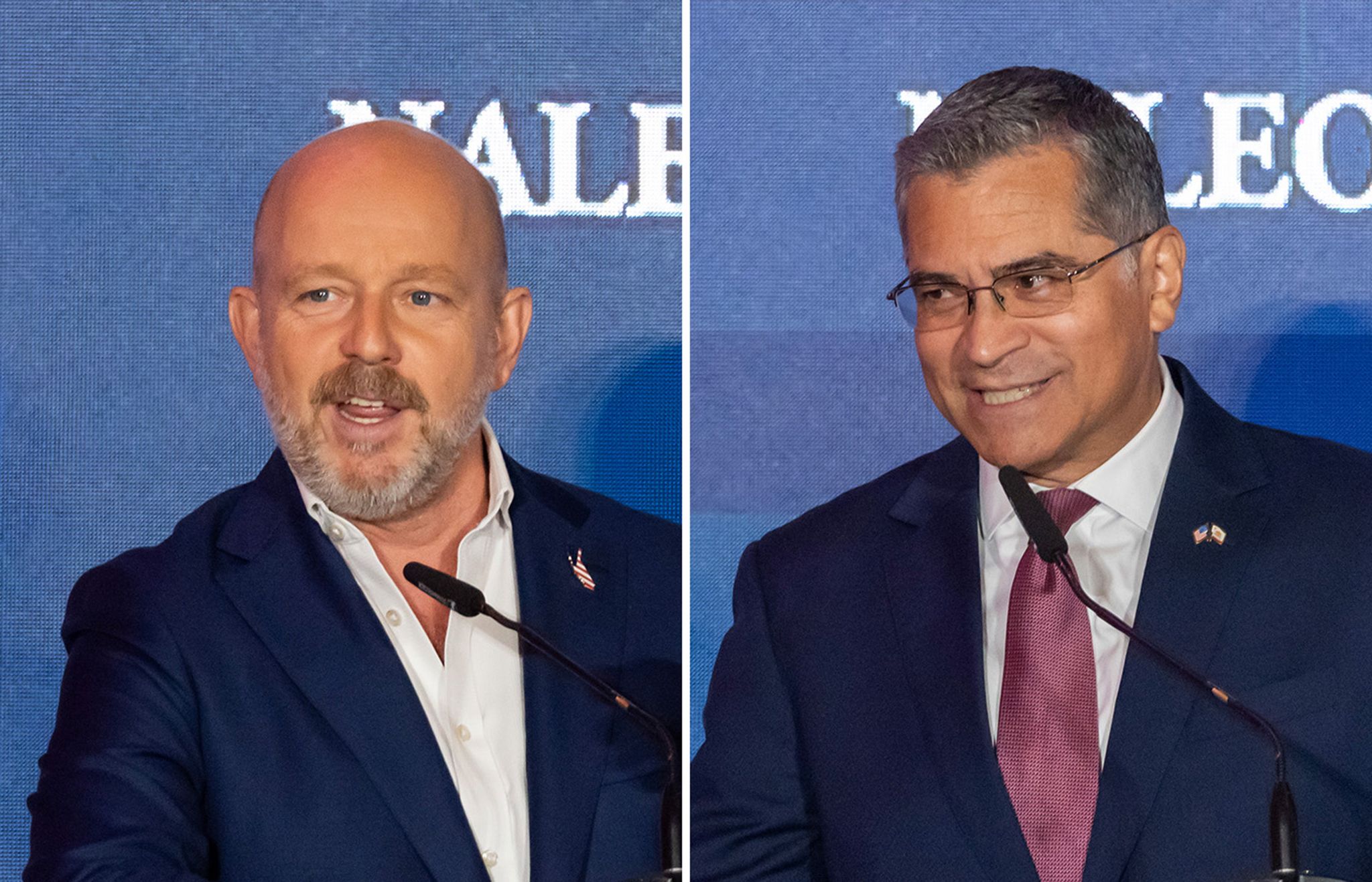
SACRAMENTO — In the race for California’s governorship, Republican candidate Steve Hilton has captivated voters with ambitious promises and engaging advertisements, while his opponent, Democrat Xavier Becerra, has opted for a more cautious campaign approach, avoiding specific commitments and media scrutiny.
Despite Hilton’s vigorous campaigning efforts—including a provocative viral ad and a series of state-wide appearances—polls indicate that he is significantly trailing Becerra. According to the latest data from the Institute of Governmental Studies at UC Berkeley and the Public Policy Institute of California, Becerra is leading by margins of 25 and 22 points respectively.
Historically, Republicans have struggled to gain traction in California, with no statewide office wins in two decades. The state’s voter registration leans heavily Democratic, with approximately 45% registered as Democrats compared to only 25% as Republicans, making Hilton’s path to victory particularly challenging.
Hilton’s campaign promises span a wide range of issues, including creating a new office dedicated to fun and freedom and halving utility bills. He has even vowed to lower California gas prices to $3 per gallon, although he himself noted the difficulty of such changes given the Democratic-majority legislature’s previous policies.
In contrast, Becerra, the state’s attorney general, has adopted a strategy focused on broad policy goals rather than specific promises. He aims to boost healthcare access and lower living costs without committing to detailed proposals, perhaps reflecting concerns over the backlash faced by Governor Gavin Newsom for failing to deliver on high-profile campaign pledges.
While Becerra has maintained a low profile and limited his public appearances, he made a press conference appearance in August to advocate for voting rights legislation but left without addressing reporters’ questions. His campaign has provided fewer open-press events compared to Hilton, who has been proactive in seeking media coverage.
Political analysts suggest that Becerra’s cautious approach is effective given his significant lead in the polls. Democratic strategist Roger Salazar noted, “When you’ve got a lead like this, there’s always a tendency to want to at least default to first do no harm.” Becerra’s less aggressive strategy has not hindered him, according to political science professor Lisa Bryant, who emphasized that strong Democratic voter turnout is likely favorable for him.
Hilton has also faced challenges in his campaign tactics. Some of his advertisements, including one featuring suggestive scenarios designed to engage younger voters, have drawn criticism even from some conservative allies. Republican attorney general candidate Michael Gates labeled the ad as “deeply out of touch” with California family values.
Financially, Becerra has a substantial edge, reporting $33 million in donations compared to Hilton’s $23 million. Political strategist Rob Stutzman commented on Hilton’s unorthodox methods, stating that controversial advertising can be a strategic way to gain attention when a candidate is significantly out-funded.
As the race approaches its key dates, including the election itself, it remains to be seen how Hilton’s lively campaign efforts and Becerra’s steady, low-profile approach will influence voter sentiment in California.
