




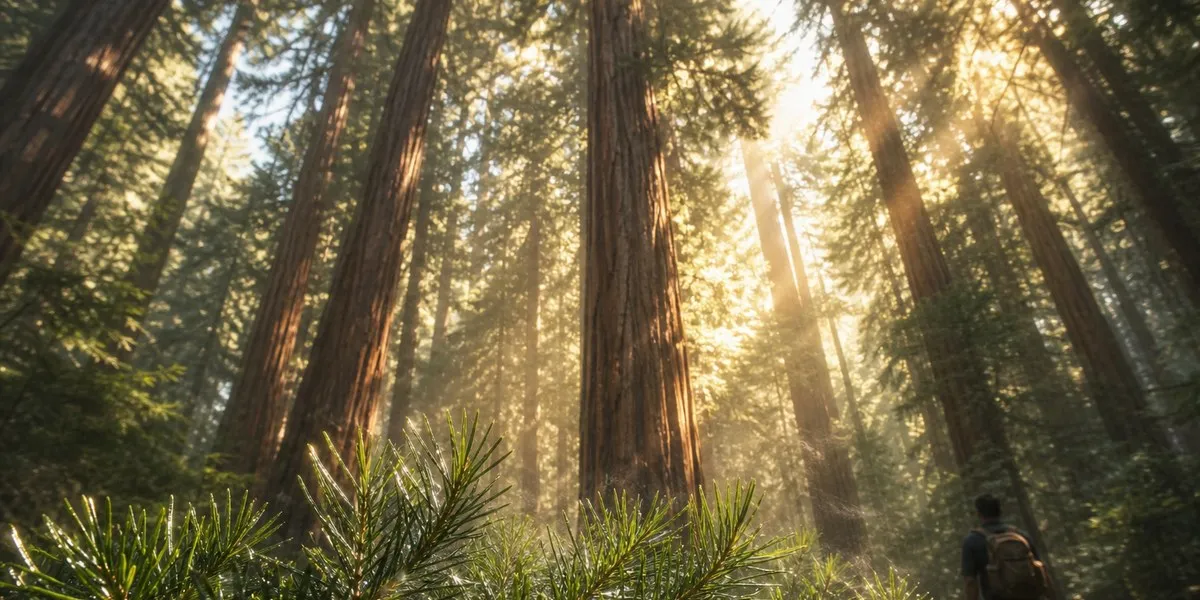
Research conducted in the Garcia River Forest in Mendocino County, California, indicates that California redwoods (Sequoia sempervirens) significantly reduce their photosynthetic activity at elevated temperatures. This decline in photosynthesis could have serious implications for the long-term survival of the species and its forests’ capability to store atmospheric carbon, according to findings published in the journal JGR Biogeosciences on September 22.
Leaf Temperature Crucial in Assessing Stress
From 2022 to 2024, scientists collected leaf samples from redwoods once or twice a month. They measured the leaves’ temperatures and fluorescence, which serves as an indirect measure of photosynthesis. One sample was wrapped in foil to allow the researchers to evaluate the maximum potential rate of photosynthesis.
On particularly hot days, sunlit leaves were found to be up to 10 degrees Celsius hotter than the surrounding air, indicating a level of stress that affected the leaves’ ability to regulate temperature, said Lily Kleineck, the study’s lead author and a doctoral student at the Plant Optics Laboratory at the University of California, Davis.
During times of heat, redwoods appeared to close their stomata—microscopic pores that manage gas exchange. This closure was aimed at reducing water loss through evaporation but concurrently restricted the intake of carbon dioxide necessary for photosynthesis.
Laboratory experiments further revealed that increased temperatures reduced photosynthesis rates even when stomata remained open, which suggests that heat directly limits the redwoods’ photosynthetic capacity. The authors noted that the specific temperature thresholds at which this damage becomes irreversible have yet to be sufficiently researched.
