




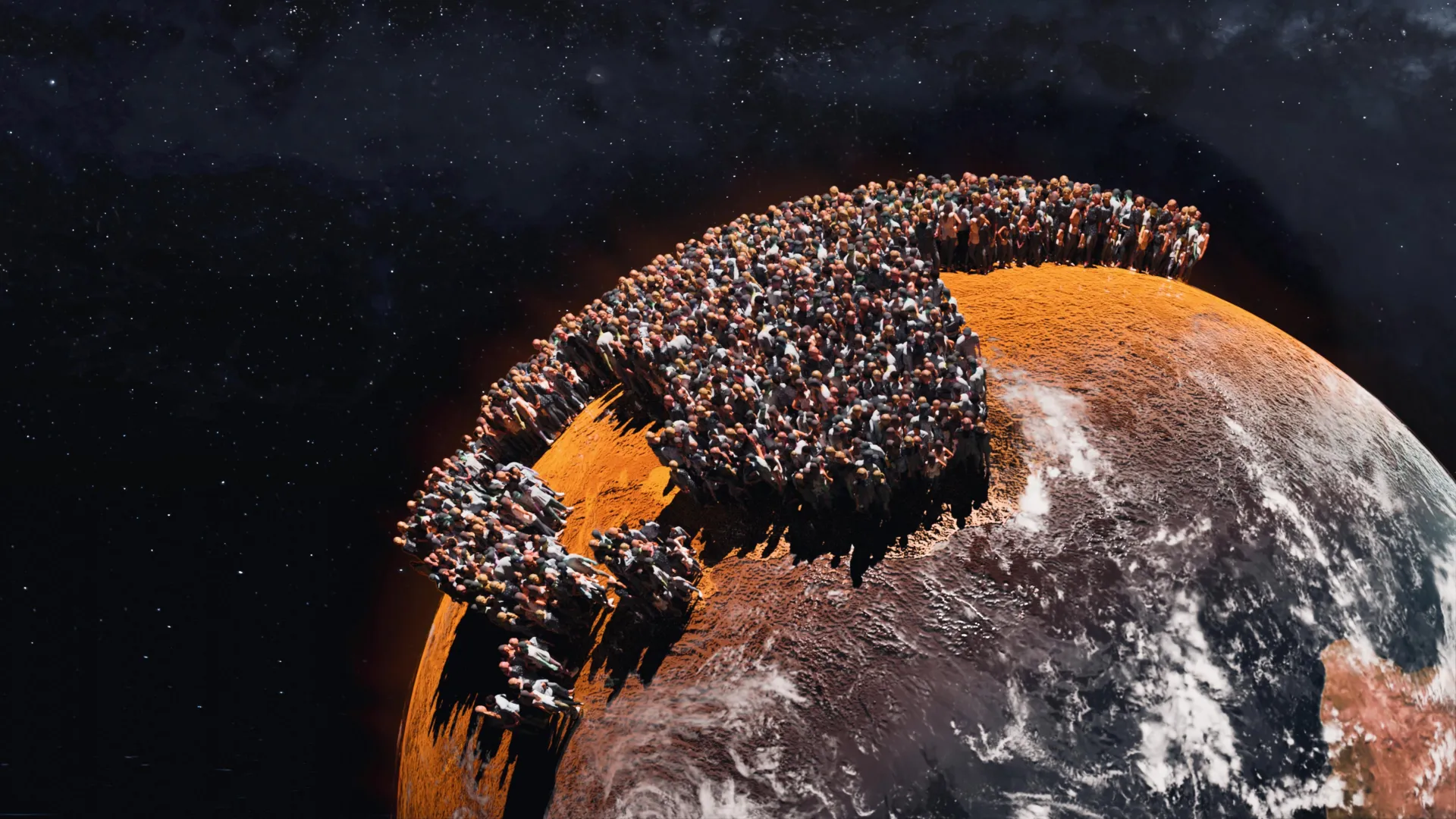
In a 1960 article published in the journal Science, scientists predicted that on November 13, 2026, the global human population would approach infinity, resulting in catastrophic consequences. The authors, Heinz von Foerster, Patricia M. Mora, and Lawrence W. Amiot, claimed that human numbers might exceed exponential growth rates, leading to a scenario where humanity could be “squeezed to death.” The article gained significant attention for its bold claim and rigorous mathematical underpinnings.
Von Foerster and his co-authors suggested that human populations are unique in their capacity to foster collaboration and resolve challenges, which could enable ongoing population growth. After presenting historical data on global population estimates, they forecasted that the world population would continue expanding dramatically, necessitating a coordinated effort to reduce birth rates by half to avoid the predicted disaster.
The notion of impending doom resonated widely, capturing public interest and sparking media coverage, including articles in Time and The New York Times. The prediction became the foundation for various discussions, from academia to pop culture, including references in a series of Pogo comic strips. Although it was sometimes viewed humorously, the article’s implications were taken seriously by many, leading to ongoing debates in the scientific community.
Throughout the 1960s and into the 1980s, the so-called “doomsday equation” was frequently cited in educational materials related to genetics, ecology, and demography. Remarkably, its population projections remained accurate for several decades. However, by 1993, these predictions began to fall behind actual population trends, as global birth rates started to decline. Today, the birth rate is approximately half of what it was in 1960.
As the November 2026 date approaches, experts believe that the world is unlikely to experience the catastrophic scenario outlined by von Foerster and his colleagues. The growth of the human population is no longer following the trajectory that the authors once predicted. Lessons from this prediction may serve as a reminder of the importance of how we communicate critical issues, combining rigorous scientific research with compelling narratives to engage a broader audience.
As the scientific community reflects on the 1960 article, it remains an example of how well-presented ideas can capture attention and provoke discussion on important topics, emphasizing the balance between creativity and factual accuracy in conveying scientific concepts.
