




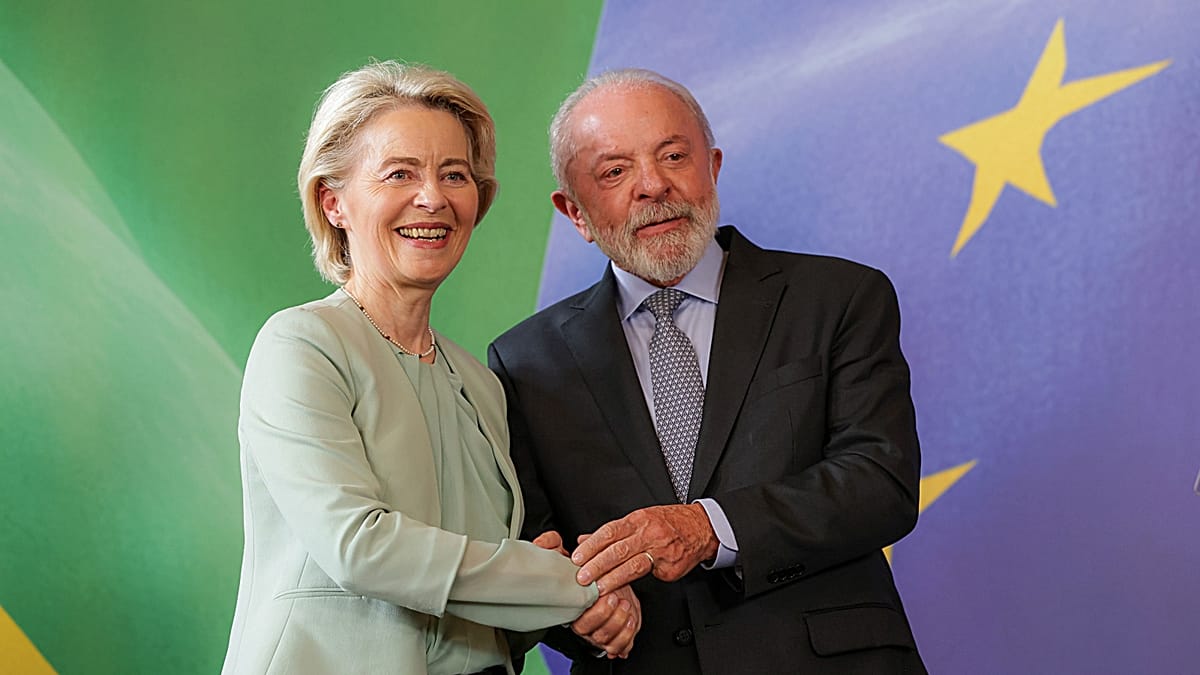
European leaders have expressed strong support for Brazilian President Lula da Silva following his re-election for a fourth term, a development that comes as a surprise to many who anticipated a rise in right-wing influence in Brazil, the largest country in Latin America. Lula’s victory strengthens a key alliance for the European Union.
Among the first to congratulate Lula were European Commission President Ursula von der Leyen and European Council President António Costa. They noted their previous collaborations, particularly regarding the EU-Mercosur trade deal, which involves Brazil along with Argentina, Paraguay, and Uruguay. This agreement, signed in January, was viewed as a significant counter to previous US trade policies, particularly those from former President Donald Trump, who had imposed tariffs that affected trade relations.
In her message on social media, von der Leyen stated, “Congratulations to my friend, Lula. Democracy and multilateralism have won in Brazil. Europe’s partnership with Brazil is thriving. We will remain by your side for the years to come.” She emphasized their commitment to free trade, a rules-based global order, and ambitious climate initiatives.
Costa also reached out to Lula directly, stating, “The Brazilian people have spoken. We will continue to work together to deepen our ties, tackle global challenges and build a more peaceful and prosperous world.”
Leaders from across Europe echoed this sentiment. French President Emmanuel Macron urged a strengthening of the strategic partnership, while Dutch Prime Minister Rob Jetten and Portuguese Prime Minister Luís Montenegro also expressed support for Lula’s administration. Spanish Prime Minister Pedro Sánchez lauded Lula’s win as a “great victory” and connected it to his own country’s political landscape, predicting a resurgence of progressive politics in Spain.
The Brazilian election results indicated a clear win for Lula, who received approximately 51.8% of the vote, surpassing his opponent Flávio Bolsonaro by nearly 4.4 million votes. Bolsonaro has challenged the outcome, denying the legitimacy of the election results and claiming that a judiciary decision to extend voting hours was a “dirty trick.”
Had Bolsonaro won, it would have marked a consolidation of right-wing power in the region, an outcome that many observers had anticipated based on previous polling. Instead, Lula’s victory underscores the EU’s shifting focus as it seeks partners amid a complex global environment, balancing issues of trade and climate while navigating differing stances, such as Brazil’s close ties with Russia amid the ongoing war in Ukraine.
As the political landscape in Brazil evolves, the EU’s ongoing relationship with Brazil will likely continue to unfold, with leaders anticipating cooperation on trade, global stability, and climate action.
