




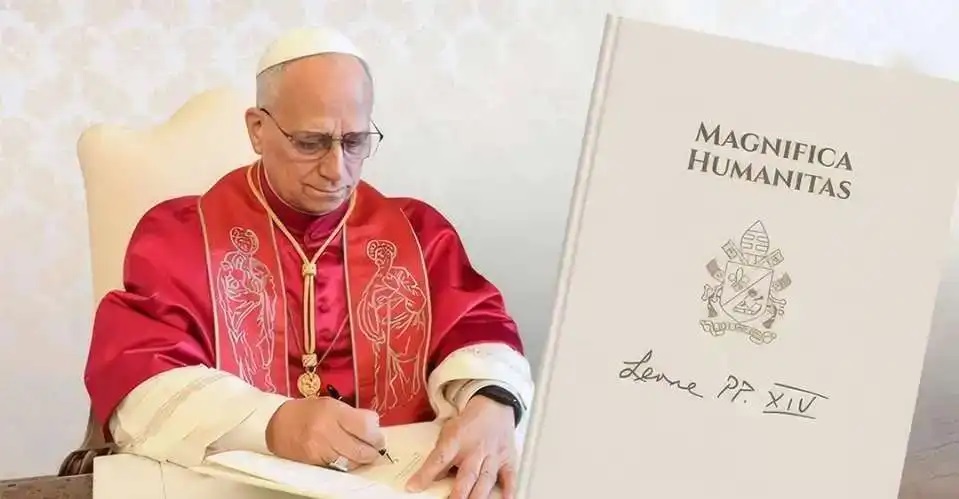
Pope Leo XIV’s encyclical, Magnifica Humanitas, signed on May 15, presents a call to the Church, urging an approach that ensures technology, particularly artificial intelligence (AI), is utilized for the benefit of humanity. Although Asia is not explicitly mentioned in the document, the region has significant interests tied to the implications of AI development.
Asia is a central player in the AI economy, with Taiwan Semiconductor Manufacturing Company (TSMC) accounting for 72.5% of global foundry revenue in the second quarter of 2026, according to TrendForce. Additionally, Taiwan and South Korea together comprise approximately three-quarters of the world’s most advanced chip-making capacity.
The region also contributes a large workforce to support AI systems, a fact highlighted by the International Labor Organization’s July report estimating that about 80 million workers in the ASEAN region are in roles susceptible to generative AI, representing 22.9% of the total workforce. In the Philippines alone, 28.1% of the workforce faces similar exposure.
In response to the encyclical’s challenges, Benedict Tang outlines four recommendations for the Church in Asia.
Recommendations for the Church’s Response
First, the Church should advocate for the often-invisible laborers who support AI systems. The encyclical notably emphasizes the “silent work of millions of people engaged in essential yet largely unseen activities,” including data labeling and content moderation. This work is predominantly carried out by young women under demanding conditions and for minimal wages. The Church could identify these workers within its communities to provide necessary pastoral support.
Second, the Church must critically evaluate significant AI projects. Paragraph 101 of the encyclical notes the high energy and water demands of current AI systems. In the Philippines, Cardinal Pablo Virgilio David has questioned the sustainability and ethical implications of large projects like the “Pax Silica” semiconductor and AI hub, which is expected to consume about 130 million liters of water daily. He emphasizes the need for accountability regarding who benefits from such initiatives.
Third, an Asian perspective can enrich the encyclical’s message. Peter C. Phan, a theologian, argues that for the encyclical to resonate in Asia, it needs to incorporate regional views. The Church can draw from its teachings to engage in interfaith dialogues and collaborate with other religious groups, sharing common concerns about human dignity and technological ethics.
Fourth, the encyclical encourages the responsible use of technology. Pope Leo has described technological innovation as a form of divine participation. Tools like Magisterium AI, developed by Longbeard, can support Catholic education by providing answers based on 40,000 Church documents across 190 countries. However, it is essential for users to verify the information with trusted sources, as these tools are not replacements for personal guidance from clergy.
The encyclical ultimately calls for a commitment to maintaining our humanity amidst rapid technological advancements. Pope Leo emphasizes the Church’s mission to exemplify a human-centered approach, which is particularly crucial in regions like Asia, where Catholic communities often constitute a minority.
