




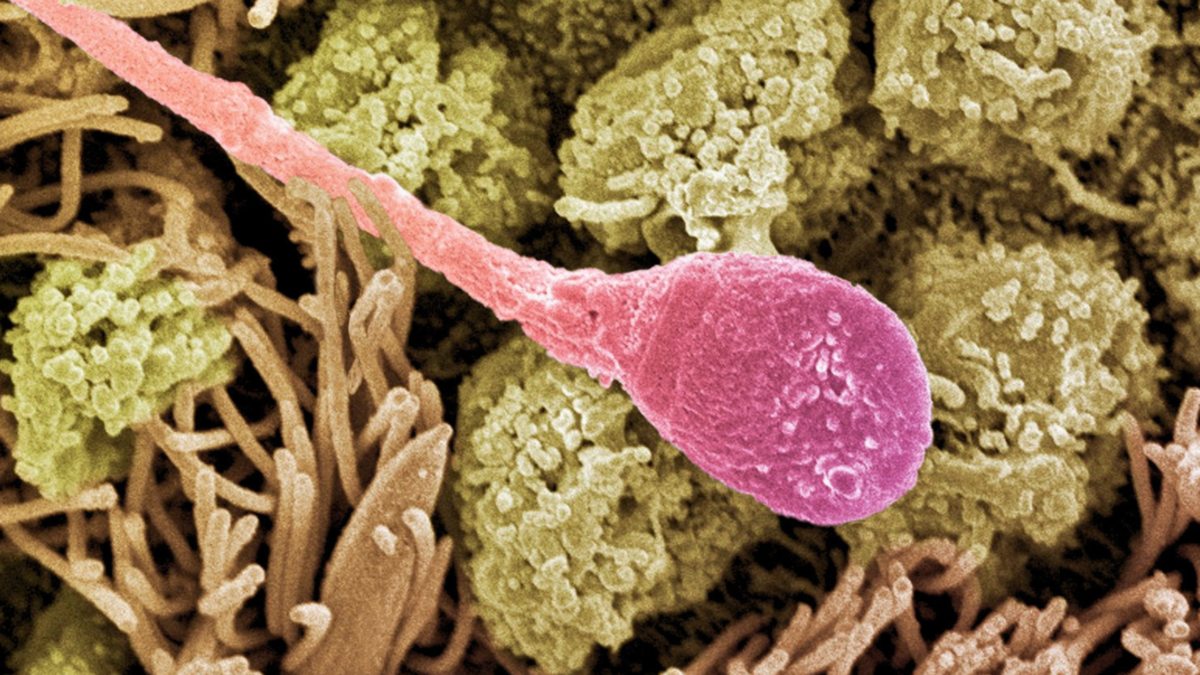
Recent research has uncovered a significant role for amyloid fibers found in semen, showing that they can facilitate the entry of RNA molecules into sperm cells. This discovery was made by researchers at Columbia University’s Zuckerman Institute, who published their findings in the journal Molecular Cell.
The study revealed that the amyloid fibers, predominantly composed of a fragment of the enzyme prostatic acid phosphatase (PAP), can bind with RNA and enter sperm. These RNA molecules are essential for early embryonic development, carrying instructions for protein synthesis and regulating gene activity.
Anthony Fitzpatrick, a structural biologist, described the findings as “wild biology,” noting that amyloids are typically associated with neurodegenerative diseases like Alzheimer’s and Parkinson’s, yet they serve functional roles in various biological processes, including sperm development.
In lab experiments, the researchers found that the positively charged PAP fragments bound with negatively charged RNA, forming droplets that evolved into the amyloid fibers. Notably, RNA played a crucial role in assembling its own carrier, indicating a unique interaction between the two components.
Further investigation using bull sperm revealed that the amyloid fibers could be traced inside the sperm cells via techniques like cryo-electron tomography. Fitzpatrick remarked on the significance of observing these structures within the cells, stating it was “extraordinary.”
Following fertilization experiments with mouse sperm and eggs, the team discovered that sperm exposed to amyloid fibers contained RNA, which also appeared in the subsequent mouse embryos. The presence of RNA was tracked using modified carbon and nitrogen isotopes, showing greater amounts of labeled RNA reached the embryos when the fibers were involved.
Interestingly, embryos formed from sperm treated with RNA and amyloid fibers produced at least ten times more of a green light-emitting protein than those that received the RNA alone, suggesting that the fibers enhance RNA delivery and functionality.
While the findings provide insights into RNA transport from seminal fluid into sperm and subsequently into embryos, the long-term implications of the fibers on embryonic development remain uncertain. Fitzpatrick acknowledged that the fate of these fibers post-entry into the embryo is yet to be determined.
The researchers hope that understanding this pathway could aid in developing innovative methods for RNA delivery, particularly for addressing metabolic disorders that can be inherited via paternal epigenetics. They noted, however, that their studies did not involve human embryos, and further research will be necessary to evaluate the natural behaviors of these fibers in biological contexts.
The study is accessible in the journal Molecular Cell.
