




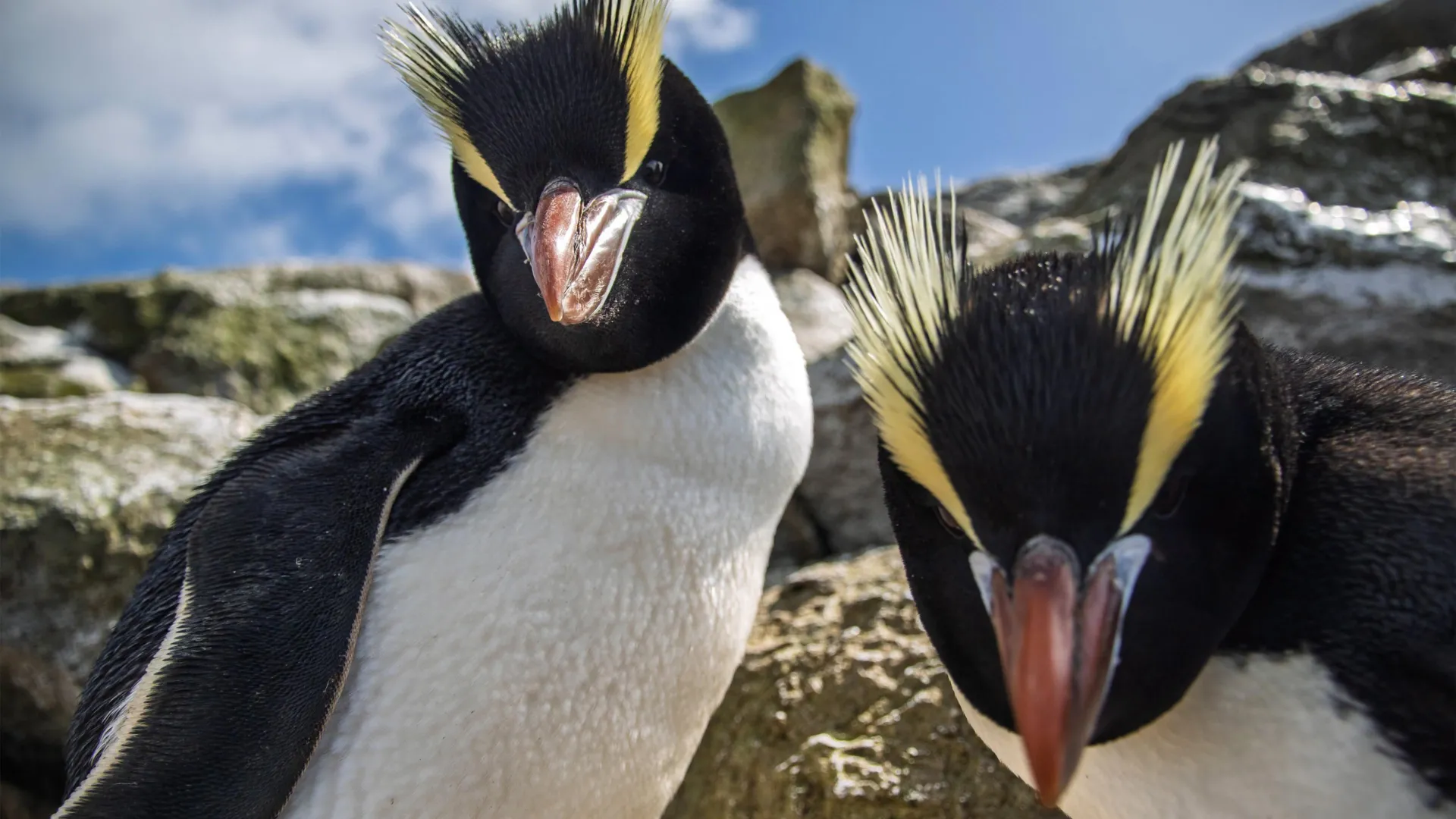
A recent study conducted by the University of Otago has revealed significant population disparities among Erect-crested penguins, one of New Zealand’s least understood penguin species. While one population of these penguins has remained stable for over 25 years, another has seen a decline of more than 40 percent in the past three decades.
The research was published in PLOS ONE and was led by Dr. Thomas Mattern from the Tawaki Project, which involves collaboration between experts from the university’s Departments of Zoology and Marine Science. The study also partnered with the Antarctic Research Trust and the Global Penguin Society.
Drone Surveys Highlight Population Divide
Erect-crested penguins breed exclusively on the remote Bounty and Antipodes islands, located approximately 800 kilometers southeast of New Zealand’s South Island. To assess their populations, researchers conducted extensive drone surveys between 2022 and 2024, marking the first comprehensive population count for the entire species.
According to the results, the Bounty Islands, covering just 50 hectares, host nearly the same number of breeding pairs (approximately 27,800) as the larger Antipodes Islands (about 29,800), which is historically viewed as the species’ stronghold. Dr. Mattern noted that the population on the Bounty Islands has remained consistent, contrasting sharply with the Antipodes Islands, which has experienced a significant decline.
“The Antipodes Islands population has declined by more than 40 percent since 1995,” Dr. Mattern explained, emphasizing the troubling trend in that region.
Researchers suggest various factors may contribute to the contrasting outcomes for these populations. Natural predators, such as skuas, which prey on penguin eggs and chicks, may pose a greater threat to the declining Antipodes population. As the colonies decrease in size, the protective advantage of nesting in large numbers diminishes, increasing vulnerability to predation.
Dr. Klemens Pütz of the Antarctic Research Trust indicated that the decline of Eastern Rockhopper penguins in the second half of the 20th century might also impact Erect-crested penguins. As Rockhoppers have diminished in number, skuas may be shifting their predation focus to Erect-crested penguin nests.
Other challenges include increasingly severe storms, which have led to landslides on the Antipodes Islands, fragmenting breeding colonies. Additionally, the two populations exhibit different migration patterns after the breeding season, potentially exposing them to various environmental pressures.
Dubbed “Schrödinger’s Penguin” by researchers, this situation draws an analogy to a well-known thought experiment in physics. Dr. Mattern explained that while the penguin scenario defies simplistic assessments, examining each population individually unveiled their distinct circumstances.
The Erect-crested penguin is classified as “Endangered” on the International Union for Conservation of Nature Red List. Current conservation efforts have focused less on this species compared to the more widely recognized hoiho or yellow-eyed penguin. Dr. Mattern voiced concerns that misleading assessments of the species’ overall status could negatively affect conservation measures, particularly as industrial fishing poses threats, especially to the stable Bounty Islands population.
Continued research and targeted conservation strategies will be crucial for protecting the future of the Erect-crested penguin, especially in light of the stark differences between the two island populations.
