




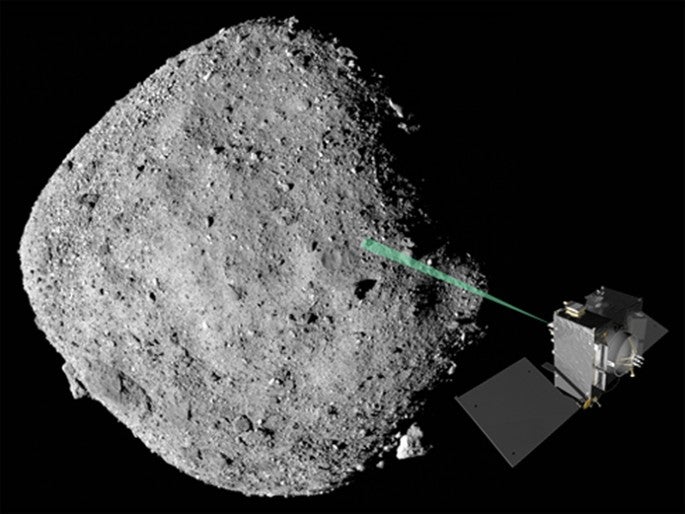
New Insights on Asteroid Bennu’s Formation Location
Recent analysis of asteroid Bennu’s samples suggests that it may have formed much closer to the Sun than previously believed. This finding stems from isotopic measurements taken from material returned by NASA’s OSIRIS-REx mission, revealing a close resemblance between Bennu, asteroid Ryugu, and rare carbonaceous chondrites known as CI meteorites.
Researchers at ETH Zurich conducted isotope analysis, focusing on titanium, chromium, and iron isotopes in the 120 grams of material brought back from Bennu. Their findings indicate that all three bodies likely originated from a similar source of primitive Solar System dust, previously thought to be located further away in the comet-forming region.
The new data suggests that Bennu-like material instead formed just beyond the ancient water-ice line, a region that serves as a transition zone between the inner and outer Solar System. The researchers propose that early Jupiter played a significant role by acting as a size-selective filter, capturing larger particles while allowing finer dust to cross its orbit and mix into the material that formed Bennu and similar asteroids.
These findings may reshape the understanding of where these ancient materials originated. The isotopic compositions of the Bennu samples showed consistent patterns, particularly in titanium and iron, while chromium displayed more variability attributed to later alteration processes involving liquid water on Bennu’s parent body.
The shared isotopic traits suggest that these bodies could have formed in a shared region of the protoplanetary disk, or may potentially trace their roots back to related parent bodies. This distinguishes Bennu from most other known meteorite groups and highlights its unique chemical family.
Implications for Planetary Formation
Researchers identified the water-ice line as a plausible formation zone due to its role in the physical and chemical evolution of materials in the early Solar System. Here, water vapor could condense and facilitate the gathering of solid materials, potentially accelerating the formation of larger bodies. This background helps explain the evidence of water content found in the Bennu materials, which had likely included ice before geological alterations occurred.
Furthermore, the team suggests that materials similar to CI chondrites could have formed approximately 2 million years after the formation of the earliest Solar System solids, a timeline that contrasts with models placing their formation further out in the Solar System.
The new insights into Bennu’s formation challenge existing models and suggest a more complex interaction between the inner and outer regions of the early Solar System. The study underscores Bennu not merely as an asteroid but as a repository of materials that could provide a glimpse into the processes that contributed to the formation of terrestrial planets, including Earth.
Why It Matters
Understanding the origins of asteroids like Bennu helps researchers piece together the history of the Solar System and offers valuable knowledge about the building blocks of planets. As scientists continue to analyze Bennu’s samples, they aim to unravel the complexities of planetary formation and the distribution of materials in the early Solar System.
