




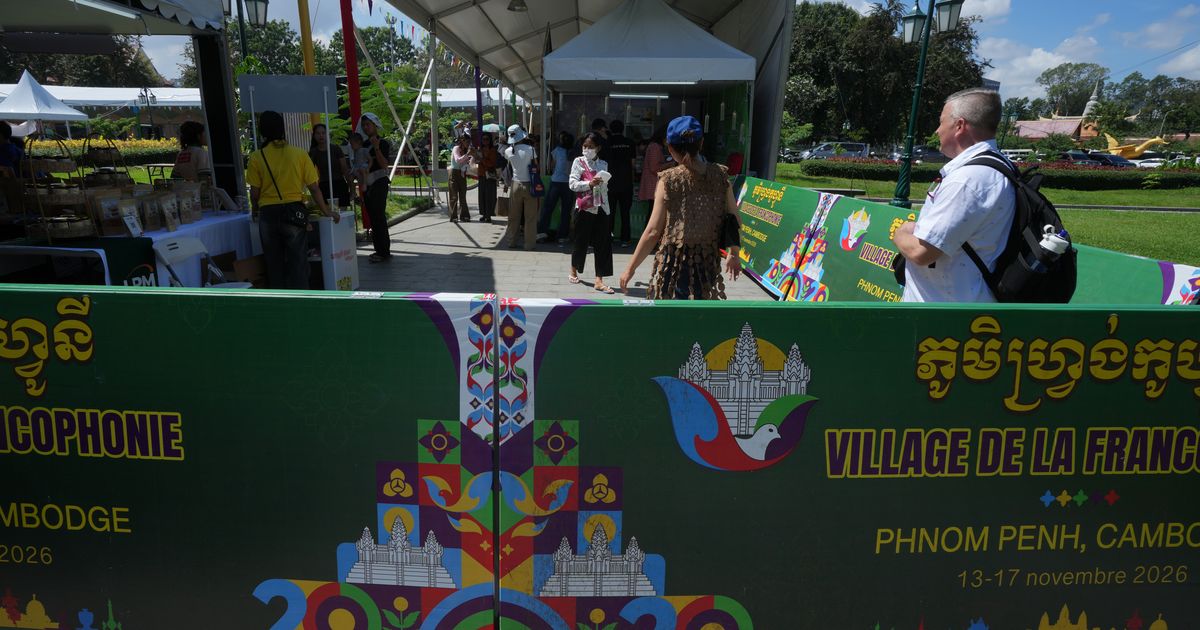
French President Emmanuel Macron will attend a biennial summit of French-speaking nations in Phnom Penh, Cambodia, starting on Saturday. This meeting comes amid ongoing domestic protests in France and challenges linked to a conflict in eastern Congo that loom over the proceedings.
On arrival, Macron and First Lady Brigitte Macron were welcomed by traditional Apsara dancers at the airport. Macron expressed his intentions to expand business opportunities for French companies in Cambodia and held discussions with Cambodian Prime Minister Hun Manet.
The Organisation internationale de la Francophonie (OIF) is hosting this three-day event, which includes representatives from 90 member states, comprising 53 full members, five associate members, and 32 observers. Cambodia will assume the summit’s chairmanship from France, which hosted the last summit in 2024.
During his visit, Macron is scheduled to tour the Angkor World Heritage Site, where he will partner with King Norodom Sihamoni to celebrate the completion of the restoration of the West Mebon temple, funded by France.
Alongside the summit, Macron faces significant public unrest back home, with recent protests involving over 600,000 citizens calling for higher wages and supporting student movements. These demonstrations have led to numerous arrests and incidents of violence.
Leadership Tensions at the Summit
The summit’s discussions on leadership are particularly contentious, as delegates will nominate a new secretary-general for the next four years. Candidates have included Rwanda’s Louise Mushikiwabo, seeking re-election, and Juliana Lumumba of the Democratic Republic of Congo (DRC), daughter of the nation’s esteemed independence leader. However, on Saturday, the DRC announced the withdrawal of Lumumba’s candidacy in favor of Romanian former Prime Minister Dacian Ciolos, citing a need for consensus.
The situation in eastern Congo, where conflict has escalated due to the activities of armed groups, including M23, adds complexity to the summit. The DRC, the United States, and United Nations experts accuse Rwanda of supporting these factions, allegations that Rwandan officials deny. The DRC recently threatened to withdraw from the OIF if Mushikiwabo is re-elected, signaling potential instability for the organization.
Macron’s office indicated that there is a consensus among members for finding a unifying candidate. France plays a pivotal role in OIF’s budget and decision-making due to its contributions, which amount to €71.7 million ($79 million) for 2026.
This diplomatic challenge follows similar withdrawals by Mali, Niger, and Burkina Faso from the OIF earlier this year, as those nations seek to diminish French influence in the region.
Cambodia has framed the summit’s theme, “Reinvest in Peace for Shared Prosperity and Lasting Stability,” as a nod to its own history of recovery from war and conflict. Approximately 20 world leaders are expected to participate, discussing issues such as cultural cooperation and crisis resolution. Furthermore, local activists hope to use this international attention to advocate for greater democratic freedoms within Cambodia, urging delegates to pressure the government on human rights issues.
Cambodia’s historical connection to the OIF dates back to its founding in 1970 by former King Norodom Sihanouk, and the nation became a full member in 1993. The outcomes of the summit may have lasting implications for both Cambodia’s future and the cohesion of the OIF.
