




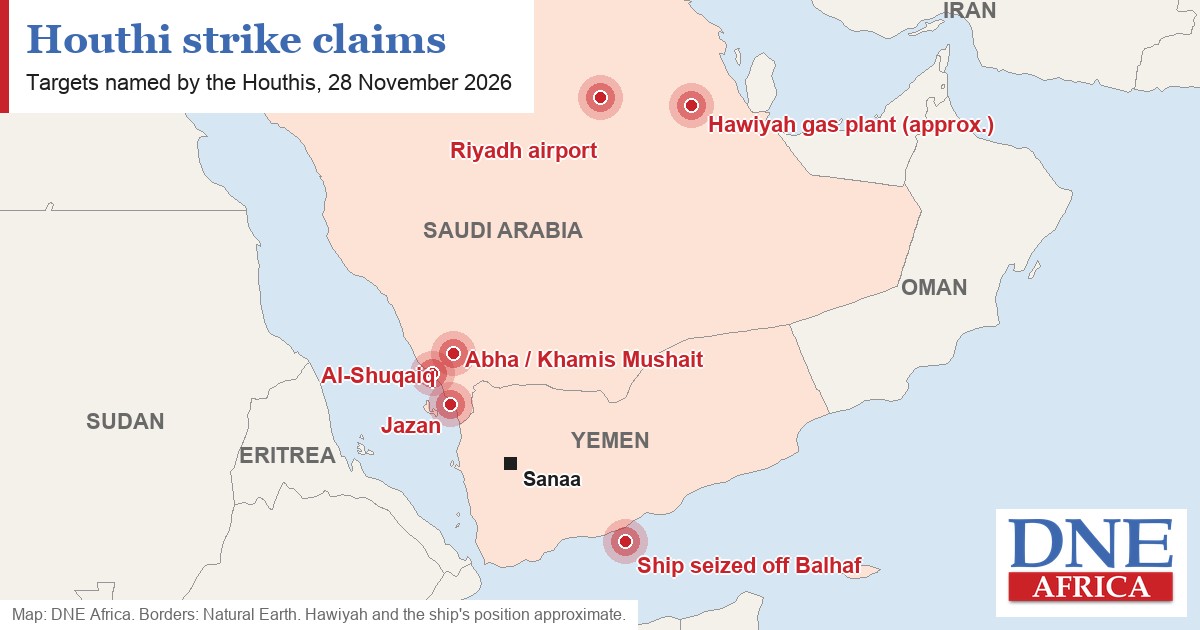
Yemen’s Houthi movement claimed responsibility for attacks on several targets in Saudi Arabia over the weekend, including King Khalid International Airport in Riyadh. The group stated that these strikes coincided with intensified military action from Saudi forces, although Riyadh has not confirmed the attacks.
Houthi military spokesman Yahya Saree reported that their operations, which reportedly occurred in the last 48 hours, targeted key locations such as the Jazan refinery and the Hawiyah gas plant. Saree described the Houthi actions as a direct response to Saudi airstrikes, framing them as an “escalation for an escalation.” He alleges that Saudi aircraft conducted 86 bombing missions in a single day across multiple Yemeni cities, including Sanaa and Taiz. These claims have not been independently verified.
The Saudi-led coalition denied confirming any Houthi claims. Coalition spokesman Turki al-Maliki stated that they had conducted a retaliatory military operation targeting Houthi launch capabilities. He did not provide further details on locations or casualties. Previously, reports indicated that Saudi strikes had hit Yemen’s territory multiple times within a short timeframe.
Separately, the UK Maritime Trade Operations center reported that armed individuals had seized a cargo ship approximately 64 nautical miles south-west of Balhaf, situated along Yemen’s Gulf of Aden coast. This event highlights ongoing tensions in the region.
Iran’s Position on the Strait of Hormuz
In another significant development, Iran’s army chief declared that the Strait of Hormuz will remain closed until Iran’s terms are addressed. On the same day, the Iranian military announced the downing of a U.S. drone in the strait. The U.S. did not confirm these claims, which could not be independently assessed.
Iran’s judiciary chief asserted that the U.S. should not expect to maintain a military presence in the Gulf, emphasizing Iran’s control over the waters stretching from Hormuz to the northern Indian Ocean. Meanwhile, the value of the Iranian rial has plunged to a record low amid these rising tensions.
Netanyahu’s Political Maneuvering
In Israel, Prime Minister Benjamin Netanyahu proposed that opposition leader Gadi Eisenkot assume the role of prime minister in a rotating unity government arrangement, citing security concerns. Eisenkot has stated he needs 24 hours to consider the offer. Following October’s inconclusive elections, where his coalition fell short of a majority, Eisenkot is tasked with forming a government by a December 6 deadline.
Opposition figure Yair Lapid criticized Netanyahu’s offer, calling it a transparent political maneuver. Likud, Netanyahu’s party, plans to meet with Eisenkot’s team to discuss coalitional negotiations further.
Ukrainian President Volodymyr Zelensky announced that an operation targeting a Russian warship in Libya was executed without prior coordination with European partners, following a warning from Italy against the conflict spreading into the Mediterranean. This comes as both nations continue to engage in military action against one another.
Three significant events are scheduled for Sunday, including coalition negotiations between Likud and Eisenkot, an OPEC+ ministerial meeting, and a snap general election in Spain. These developments may further influence global dynamics in the coming days.
