




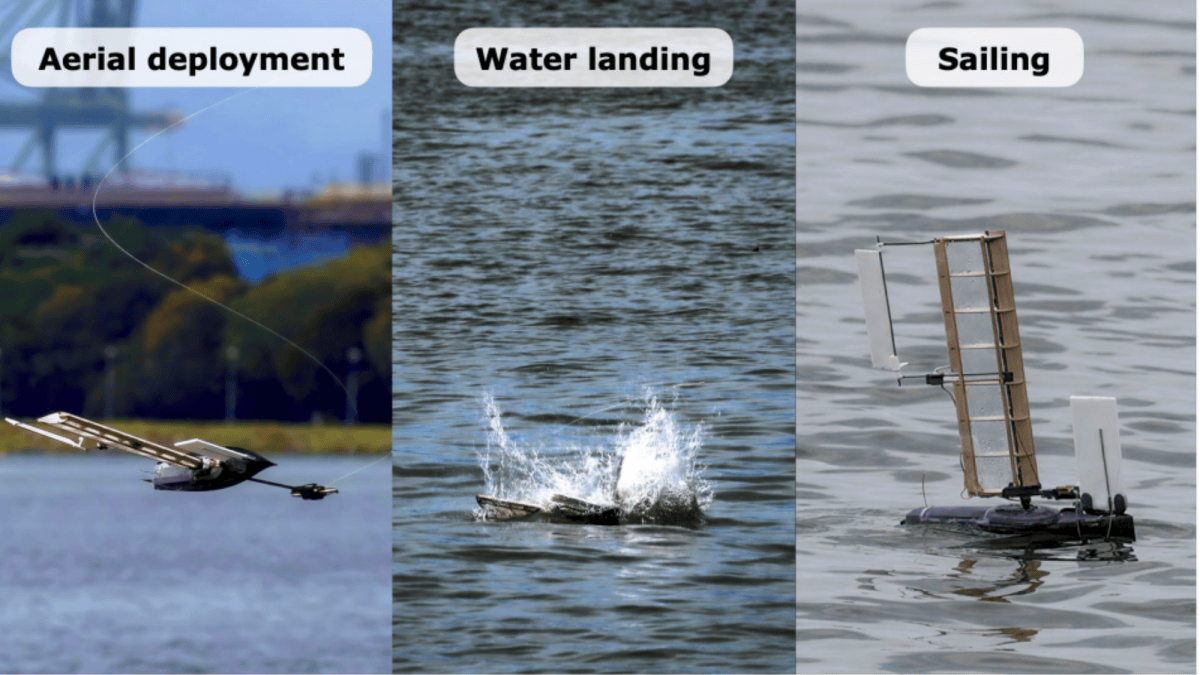
Researchers at the Singapore University of Technology and Design have developed a versatile new robot capable of flying, sailing, and swimming autonomously. Named ALBATROSS (Airborne Lander with Buoyant AuToROtating Sailing Sensor), this innovative machine aims to enhance underwater monitoring, especially in emergency situations like oil spills or chemical leaks.
Engineering a Multi-Functional Robot
Unlike existing robots, which often require separate aerial or marine vehicles, ALBATROSS can be deployed from the air and transition seamlessly to aquatic navigation. The robot, which weighs slightly over two pounds, incorporates design elements inspired by nature, drawing on features from a maple seed, mute swans, and various fish species. Its design allows it to utilize the same rigid limbs for both aerial and marine operations, eliminating the need for additional components that might add weight or complexity.
The development team conducted trials over two reservoirs in Singapore, using a drone to drop the robot from approximately 490 feet. ALBATROSS demonstrated its ability to slow its descent from about 69 mph to 15 mph using a spinning motion, reducing impact force substantially upon landing. The robot adjusts its structure to resemble a sailboat, ready to gather environmental data such as humidity and temperature fluctuations without requiring constant human oversight.
The testing showed that ALBATROSS could function efficiently, completing a three-hour operation with about 50 percent of its battery life remaining. The authors of the study emphasized that the robot’s lightweight design and minimal actuation system open up new possibilities for creating lightweight, energy-efficient marine sensing robots.
While ALBATROSS showcases significant advancements in bio-inspired robotics, its current limitations include vulnerability to severe weather conditions, indicating that further developments are needed before it can be deployed in high-stress environments such as storms.
According to engineers Raphael Zufferey and Andre Farinha, ALBATROSS exemplifies how nature can guide innovation while allowing researchers to abandon the confines of evolution’s existing solutions. Through this approach, they aim to redefine bio-inspired engineering in robotics.
Why It Matters
ALBATROSS represents a significant step forward in robotic design, particularly for environmental monitoring applications. Its ability to adapt between different environments could revolutionize how researchers collect data in challenging conditions, contributing to better responses during environmental emergencies.
