




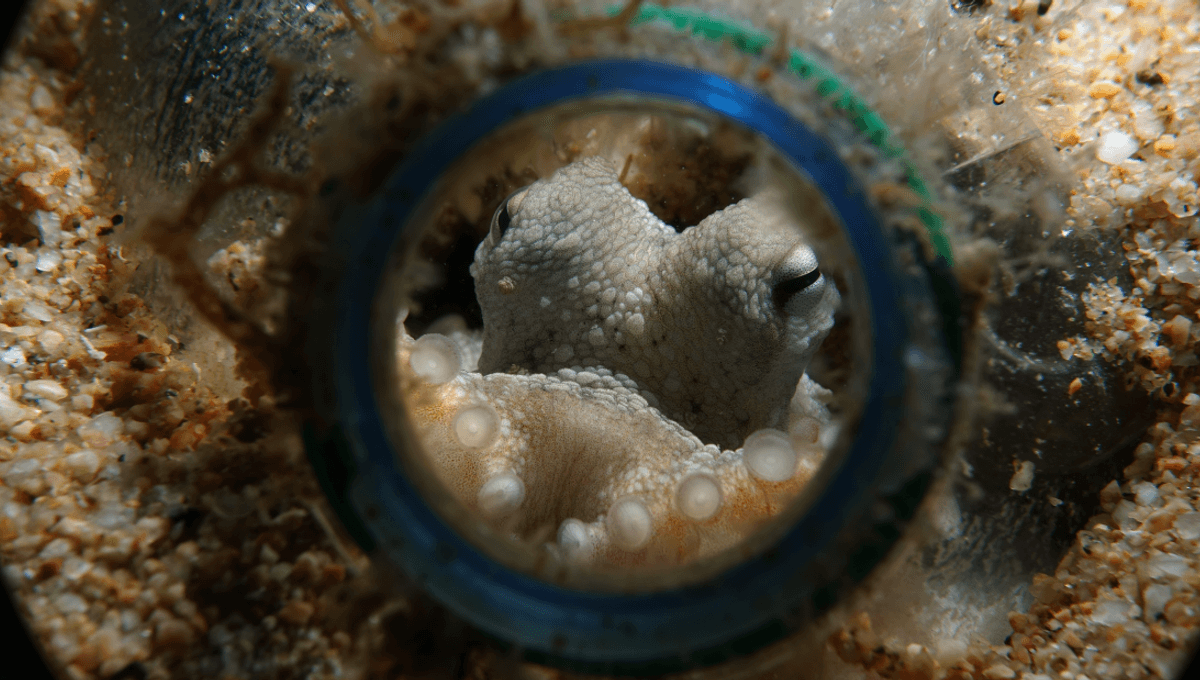
Researchers have made notable strides in understanding how octopuses, known for their remarkable ability to squeeze through tight spaces, navigate seemingly impossible gaps. A team of scientists conducted experiments using common octopuses (Octopus vulgaris) and Mayan octopuses (O. maya) to uncover the techniques these marine creatures employ.
The study, led by researchers at the Singapore-MIT Alliance for Research and Technology (SMART) Centre, involved constructing an escape room using Perspex boxes specifically designed with holes of varying sizes. The scientists measured the distances between the octopuses’ eyes to create escape routes; the yields ranged from comfortably wide to tightly constricted gaps.
Innovative Escape Strategies
During the experiments, the octopuses showcased a variety of tactics for maneuvering through the openings. For larger holes, they typically followed a three-step method: probing the gap, inserting some arms through, and finally pushing the remaining body through. In contrast, tighter openings necessitated a four-step process, which involved the same initial steps with an added emphasis on coordinating their bodies.
Dr. Xin Wenci, the study’s first author, noted the unpredictability of working with animals compared to machines. With assistance from experienced biologists, the team managed to guide the octopuses effectively, learning about the different strategies employed as they progressed through the holes. ”We had assumed there was a common strategy for this behavior,” Wenci said, reflecting on the unexpected complexity of the octopuses’ methods.
Fellow researcher Michael Kuba from the University of Naples emphasized how this study highlights the intricate mechanics of animal movement in different contexts. He remarked, “Working with soft robotic engineers, you realize there is so much more to how they manage to do this.”
Subsequently, the team aims to apply these insights into bio-inspired robotic design, particularly for applications like search-and-rescue missions. “We would like to see whether an octopus-like robot could overcome environmental constraints and enter spaces that are difficult to reach,” Wenci added.
The findings of the study, which demonstrate the benefits of interdisciplinary collaboration between biologists and roboticists, were published in the Journal of Experimental Biology.
As researchers explore the linkage between animal behavior and robotics, their work could pave the way for innovative designs and applications in various fields.
