




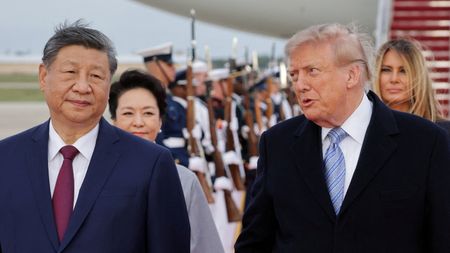
US President Donald Trump is set to embark on a pivotal trip to Asia this week, following a disappointing midterm election outcome for his party and ongoing allegations involving a Chinese spy. His tour begins in Manila, where he will engage with Southeast Asian leaders on Tuesday, before heading to Shenzhen for the Asia-Pacific Economic Cooperation (APEC) forum. There, he is scheduled to meet with Chinese President Xi Jinping and hold trilateral discussions with Russian President Vladimir Putin.
With an ongoing trade-war truce between the US and China extending through early next year, initial assessments of the Shenzhen encounter suggested it would be a low-risk meeting. However, political fallout from the midterm elections and growing scrutiny regarding his administration’s response to allegations surrounding Nvidia CEO Jensen Huang—who reportedly had ties to a suspected Chinese spy—have complicated these expectations.
Analysts, including Ruby Osman from the Tony Blair Institute, suggest that Trump might be more open to considering significant actions during this trip, given the reduced political anxieties following the midterm results. The US has already indicated it expects China to adhere to commitments made under last year’s truce between Trump and Xi.
Chinese analysts are wary that the implications of the ongoing Nvidia situation, including claims that restricted semiconductors were intended for Chinese customers, could harden US attitudes toward trade with China. Recently, US House Speaker Mike Johnson noted an emerging consensus in Congress to further limit Chinese access to advanced semiconductor technology, a sentiment likely to intensify as Democrats prepare to assume control in January.
In response, China has accused the US of fabricating the espionage narrative to justify its technological restrictions. Zhu Feng, a scholar at Nanjing University, warned that this ongoing tension may accelerate the decoupling of artificial intelligence development between the two nations, even as both seek collaboration on technology risk mitigation.
Despite the heightened climate surrounding the spy allegations, a senior US official indicated that Trump is unlikely to confront Xi directly about these matters, asserting that the Nvidia issue “should not really have any bearing on the trip.”
Trump’s objectives may center more on legacy-building rather than escalating conflicts with China. His agenda may include discussions on denuclearization with both China and Russia, as well as aims to facilitate further dialogue with North Korean leader Kim Jong Un, given his historical diplomatic efforts in the region. Victor Cha from the Center for Strategic and International Studies emphasized the emphasis on legacy, particularly concerning North Korea, in Trump’s remaining time in office.
Analysts also suggest that Xi may see an opportunity to leverage Trump’s diminished political standing following the elections. Beijing may prioritize preventing Trump from authorizing a proposed $14 billion arms package to Taiwan, a territory China considers its own. With the Chinese economy remaining robust, experts suggest that Xi might be content to buy time with the current administration.
Both leaders are also likely to avoid reigniting past trade disputes that could destabilize global markets. Despite US frustrations over China’s fulfillment of the truce’s terms, many expect the agreement to be extended past its January 10 expiration, with both nations recognizing the potential consequences of failing to maintain stability in their economic relationship.
