




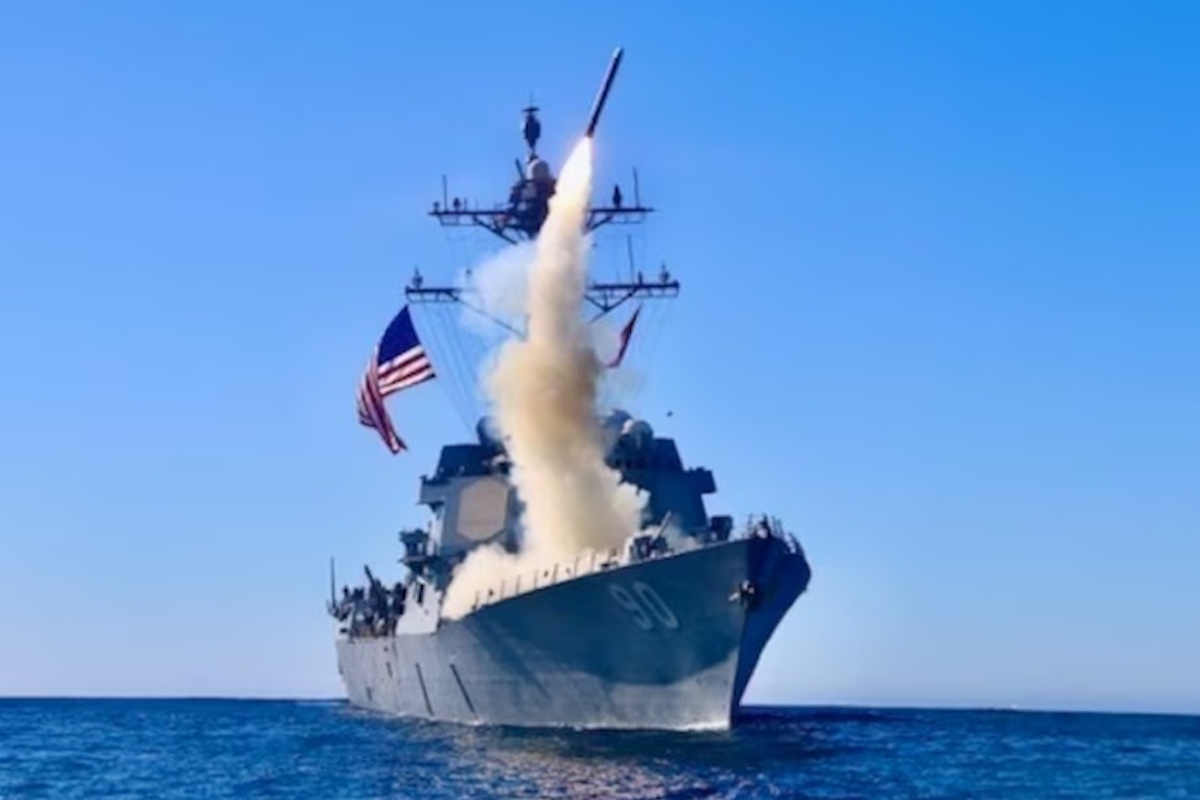
The US Navy is advancing its efforts to enhance long-range strike capabilities with plans to award Raytheon a sole-source contract for the low-rate initial production of the Joint Multiple Effects Warhead System (JMEWS) for the Tomahawk cruise missile. This initiative aims to develop a bunker-busting variant designed to effectively target deeply buried missile sites fortified by advanced air defenses.
A pre-solicitation notice from Naval Air Systems Command indicated that the JMEWS will equip the Tomahawk Block Vb with a two-stage warhead intended to penetrate hardened underground facilities such as missile silos, command centers, and other strategic sites from distances of approximately 1,600 kilometers. The contract is justified by the US Navy, which cited Raytheon’s proprietary technical knowledge and its consistent role as the missile’s sole developer since 1994. Officials noted that other manufacturers would not be able to match deployment timelines without incurring excessive costs.
While specific financial details and production targets remain undisclosed, recent budget allocations suggest funding for 35 re-certified Tomahawk missiles with upgrade kits, in anticipation of an initial operational capability expected by 2027. The operation, managed by PMA-280 at Patuxent River, Maryland, focuses on providing surface destroyers and submarines with standoff precision-strike options, minimizing the need to risk manned aircraft in contested airspace.
The decision to enhance the Tomahawk missile’s capabilities is partly driven by lessons learned during the Iran conflict, where US munitions struggled to effectively neutralize well-protected underground missile sites. Despite early successes in damaging Iran’s military infrastructure, the country rapidly restored its capabilities and sustained high rates of missile launches.
Experts, including Decker Eveleth from the James Martin Center for Nonproliferation Studies, indicate that similar challenges may arise in a potential conflict over Taiwan, where the People’s Liberation Army Rocket Force (PLARF) has developed extensive subterranean networks to shield its missile assets. Eveleth emphasized that simply targeting missile launchers may not suffice; instead, it is critical to eliminate these underground facilities to mitigate the missile threat.
However, the Tomahawk’s effectiveness against China’s robust air defense system remains uncertain. Historical performance against adversaries with less sophisticated defenses raises questions about its capabilities in a scenario involving a peer competitor like China. Additionally, the US military faces challenges related to operational logistics, including limited stockpiles of standoff munitions and the vulnerability of launch platforms to enemy countermeasures.
Concerns about potential nuclear ambiguity also arise with the cruise missile strikes on the Chinese mainland, especially as the US develops a nuclear-armed Sea-Launched Cruise Missile. This evolving situation necessitates a careful assessment of operational strategies to ensure that conventional military actions do not inadvertently escalate into a nuclear conflict.
The upcoming deployment of the JMEWS-equipped Tomahawk Block Vb will hinge not only on the missile’s design but also on the US military’s capacity to bolster munitions production, secure launch platforms, and establish measures to manage escalating tensions in the region.
