




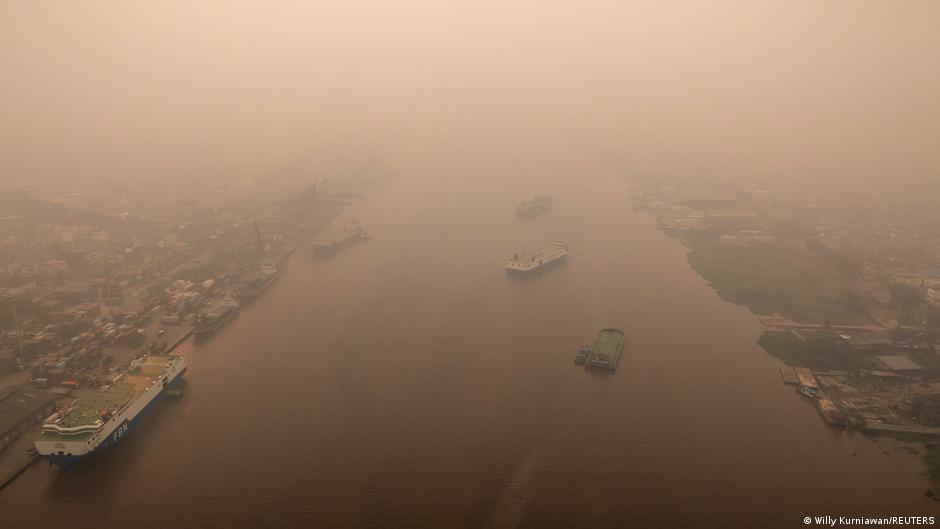
Indonesia is grappling with its worst wildfire season in over a decade, highlighting ongoing challenges in managing the region’s recurrent haze crisis. Forest and land fires have engulfed parts of Sumatra, Borneo, and Papua, sending smoke across large swaths of Indonesia and into neighboring Malaysia and Singapore.
The combination of a prolonged dry season and this year’s El Niño phenomenon has exacerbated an already dire situation, exposing millions to hazardous smoke laden with harmful particles. Indonesia’s Health Ministry reported more than 170,000 cases of acute respiratory infections in areas affected by the haze between August and mid-September, including over 40,000 cases in young children.
The haze crisis has prompted the closure of hundreds of schools in Malaysia and affected 1.4 million Indonesian students, forcing a shift to remote learning, though the overall economic impact remains unclear.
Experts note that the severe weather this year is not the sole cause of the crisis. The practice of using fire for agricultural land clearing, especially for expanding palm oil and pulpwood plantations, has long contributed to land degradation and increased fire risks. The conditions resemble those seen during the catastrophic fires of 2015, which burned 2.6 million hectares and cost Indonesia approximately $16 billion in economic losses, according to the World Bank.
Paruedee Nguitragool, an associate professor at Chiang Mai University, warned that climate change may lead to more frequent haze events, making it a regional issue affecting multiple Southeast Asian nations. She called for improved regional cooperation among ASEAN countries in addressing the crisis.
In the aftermath of the 2015 disasters, Indonesia implemented significant policy changes. The Peatland Restoration Agency was established to restore degraded lands, and a moratorium on new concessions in primary forests was enacted. ASEAN also took steps to enhance regional collaboration through a new Peatland Management Strategy and the opening of the ASEAN Coordinating Center for Transboundary Haze Pollution Control in Jakarta earlier this year.
Despite these initiatives, experts argue that underlying problems persist. David Mark Taylor, a professor at the National University of Singapore, noted that extensive areas of peatland remain drained and vulnerable to fire during droughts. The Peatland and Mangrove Restoration Agency, which was dissolved at the end of 2024, left questions about the capacity to maintain restoration efforts within other government sectors.
Current ASEAN frameworks face challenges in enforcing compliance and ensuring that member states adhere to haze management commitments. Taylor emphasized that the ongoing demand for inexpensive commodities like palm oil fuels the pressure to convert forested areas and peatlands into plantations.
As the haze crisis continues, experts stress the necessity of stronger regional collaboration. Helena Varkkey, an associate professor at Universiti Malaya, emphasized the need for ASEAN countries to pool resources and develop robust responses to prevent future crises. Mohd Talib Latif, another academic, advocated for tougher laws against burning practices and highlighted the need for technological cooperation to prepare for adverse weather conditions.
