




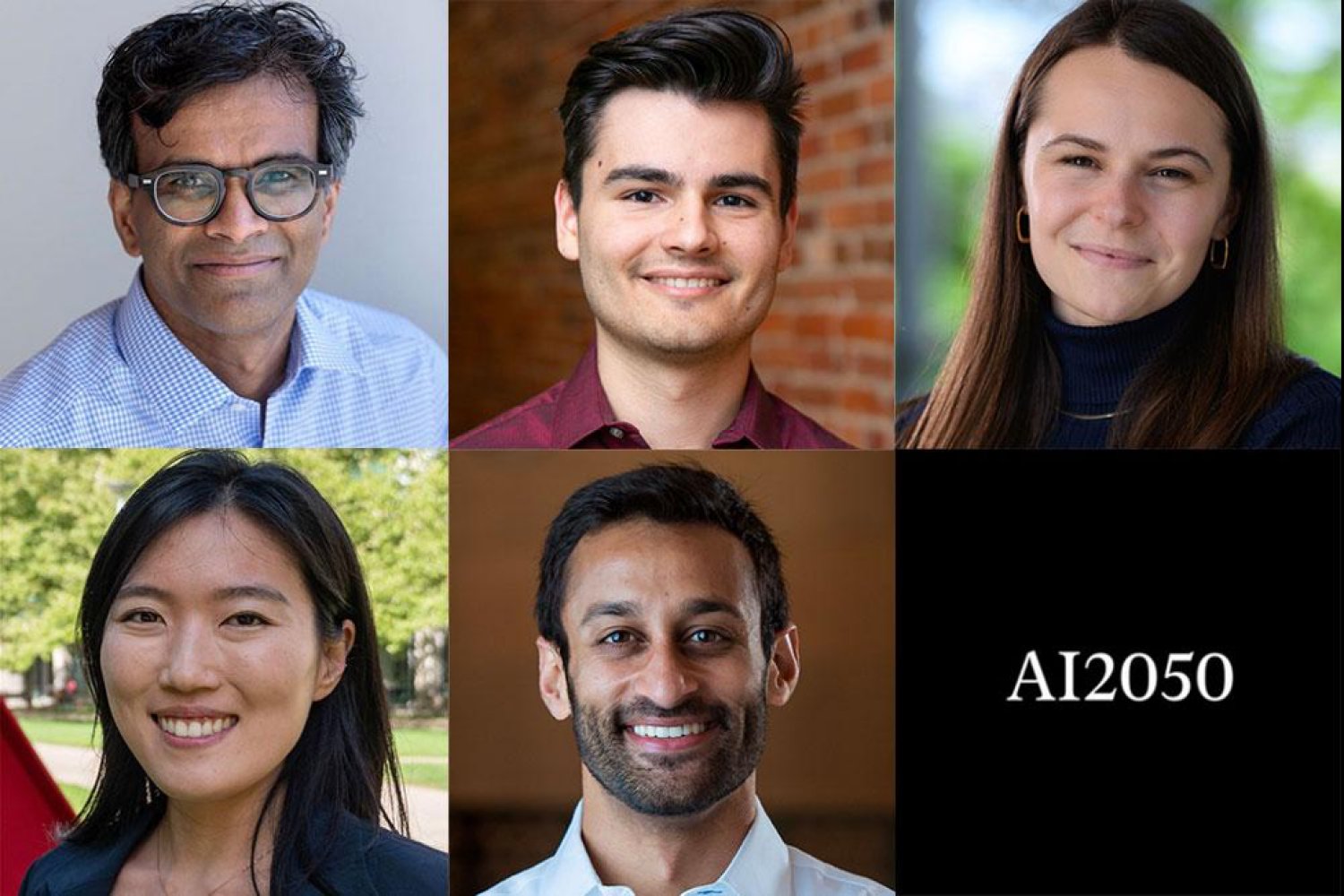
Five faculty members from the Massachusetts Institute of Technology (MIT) and two alumni have been selected as part of the 2026 cohort of AI2050 Fellows, a program designed to advance research on beneficial artificial intelligence. The recipients were announced by Schmidt Sciences, a philanthropic initiative founded by Eric and Wendy Schmidt aimed at promoting scientific innovation.
AI2050, which is co-chaired by Eric Schmidt and James Manyika, seeks to address significant challenges in artificial intelligence. Each fellow’s research will explore the question: “It’s 2050. AI has turned out to be hugely beneficial to society. What happened?” This inquiry focuses on the critical problems addressed and the opportunities harnessed to achieve a positive future for AI.
Fellowship Details
Among the selected fellows is Sendhil Mullainathan, Peter de Florez Professor at MIT, with appointments in the departments of Economics and Electrical Engineering and Computer Science. Mullainathan is a principal investigator at the MIT Laboratory for Information and Decision Systems and is noted for his work on making AI more human-centered. He is also a co-founder of several significant initiatives, including ideas42, the Abdul Latif Jameel Poverty Action Lab, and Dandelion Health. His project focuses on translating patterns recognizable by AI into testable theories.
Also recognized as an Early Career Fellow is Alex Damian, an assistant professor in the Department of Mathematics and the MIT Schwarzman College of Computing. Damian’s research centers on the mathematical foundations of deep learning, specifically in optimization dynamics and representation learning. Previously, he held a research position at Harvard University. His AI2050 project addresses effective AI model training.
Bailey Flanigan, a Theodore T. Miller Career Development Assistant Professor, also joins the cohort. Flanigan’s interdisciplinary research combines tools from various fields to enhance political methodology and public participation in democracy. Her AI2050 project is focused on gathering structured public input beneficial for lawmakers in complex decision-making.
Yunha Hwang, a Samuel A. Goldblitch Career Development Assistant Professor, works on integrating machine learning in microbial evolution and biomanufacturing. Hwang co-founded Tatta Bio, a nonprofit dedicated to genomic AI research. Her project investigates determining biological enzyme functions.
Manish Raghavan, Drew Houston Career Development Professor at the MIT Sloan School of Management, explores computational techniques for social issues, such as algorithmic fairness in hiring processes. His project aims to mitigate negative consequences of AI usage and enhance its beneficial aspects.
In addition to the faculty members, MIT alumni Irene Chen, PhD ’22, and Allison Z. Koenecke, ’14, as well as former postdoc Juan Carlos Perdomo, have been awarded AI2050 Early Career Fellowships.
