




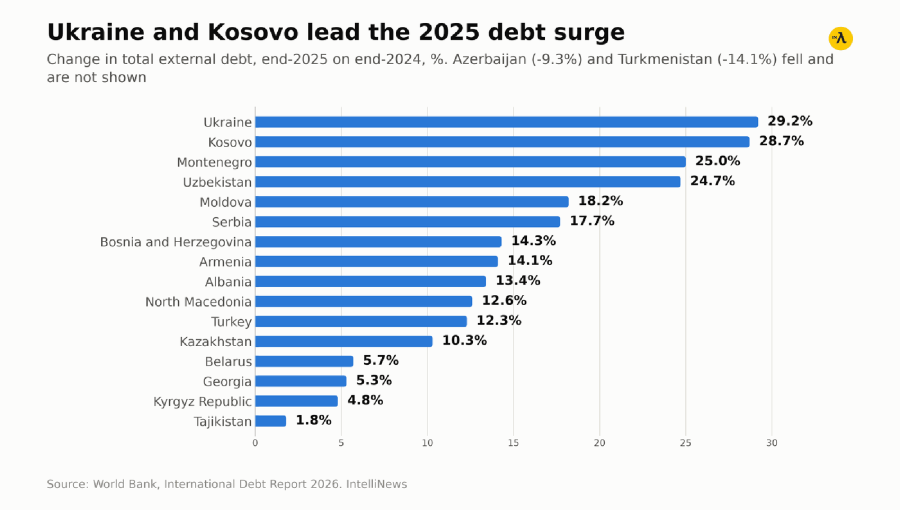
External debt in developing Europe and Central Asia rose sharply by 15.3% to $1.34 trillion in 2025, the highest increase among developing regions, according to the World Bank’s International Debt Report 2026. This increase was primarily driven by heightened borrowing in Ukraine and Turkey, which together accounted for approximately two-thirds of the region’s debt growth.
The 18-country group added about $178 billion in external debt during the year, contrasting with a more modest increase of 5.5% to $9.4 trillion across all low- and middle-income countries globally. While Sub-Saharan Africa recorded a significant rise of 10.8%, East Asia and the Pacific experienced a decline of 1.8%, largely due to a decrease in China’s borrowing activities.
The report highlights that the growth of external debt has outpaced the region’s capacity to manage its financial obligations. By 2025, external debt reached 152.2% of exports, marking a deterioration from the previous year, and interest payments consumed 6.8% of export earnings—the highest proportion in the region. Overall, total debt service rose from 22.9% to 24.8% of exports.
Ukraine, with a remarkable debt increase of 29.2% to $250.3 billion, experienced the highest percentage rise in the region. This debt now represents 403% of its export earnings and 118% of its national income. Much of Ukraine’s external debt is owed to multilateral creditors, with the European Union alone holding $82.3 billion of that amount.
Turkey, the largest debtor in the region, saw its external debt climb 12.3% to $572.8 billion. The country’s public sector issued $27.7 billion in bonds in 2025, with private firms raising an additional $23.5 billion. Turkey’s short-term external debt, representing a potential vulnerability, reached $165.8 billion, about 29% of its total external debt.
In Central Asia, borrowing patterns varied significantly. Uzbekistan’s external debt soared to $88 billion, marking a more than sixfold increase since 2015, while Kazakhstan’s debt service soared to 64% of exports. Conversely, Azerbaijan’s external debt fell by 9.3% to $12.3 billion, contrasting with increases in other countries within the South Caucasus region.
As the borrowing continues into 2026, over 10 developing countries have already exceeded their full-year 2025 bond issuance by mid-August. The shift towards commercial financing in nations such as Uzbekistan and Montenegro has introduced high borrowing costs and shorter repayment periods amid rising debt levels.
The report from the World Bank indicates ongoing challenges for the region as it grapples with the implications of increasing external debt while striving for long-term economic stability.
