




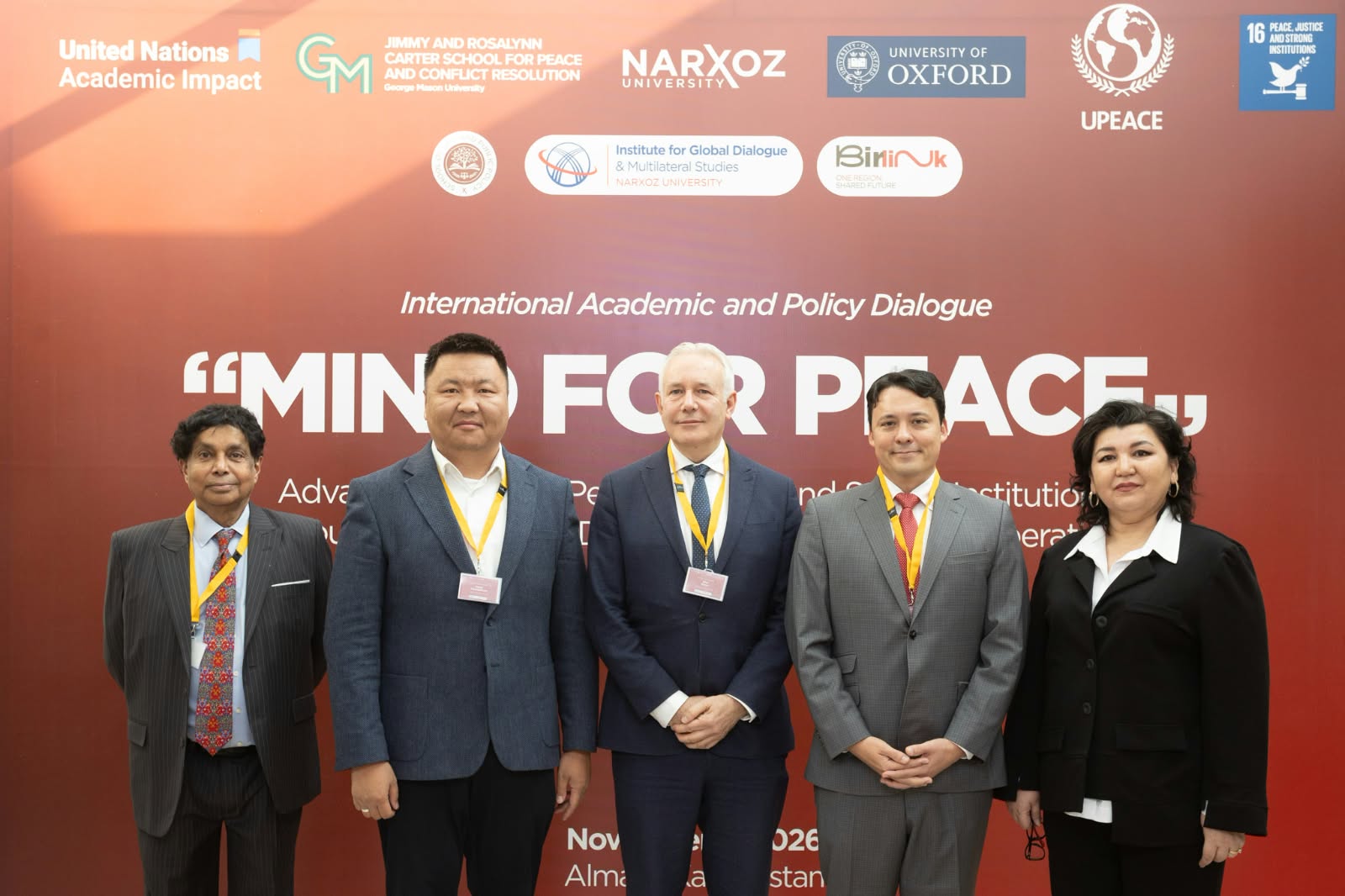
Central Asia’s potential for enhanced regional cooperation and global governance was the main focus of the Mind for Peace conference held on November 4 at Narxoz University in Almaty, according to the university’s press service. The event brought together diplomats, international organizations, and academics to discuss education’s role in promoting peace, justice, and strong institutions.
During the opening remarks, Narxoz University President Kanat Kozhakhmet underscored the significance of peace, stability, and mutual trust amid geopolitical and technological changes. He emphasized that these factors are not only political priorities but also essential conditions for sustainable development. Kozhakhmet reaffirmed Kazakhstan’s commitment to multilateral cooperation and recognized the United Nations’ central role in international affairs.
Anara Dutbayeva, an adviser with Kazakhstan’s Foreign Ministry in Almaty, stressed the importance of a coordinated regional voice and highlighted the C5+ cooperation format, which connects the five Central Asian countries with external partners. She indicated that there are ample opportunities for collaboration in sectors such as trade, transportation connectivity, artificial intelligence regulation, and water management. Furthermore, she pointed out the need for peaceful and inclusive societies supported by accountable institutions.
European Union Ambassador to Kazakhstan, Aleška Simkić, voiced support for advancing regional cooperation through the C5+ format, expressing optimism that this integration could ultimately lead to the establishment of supranational institutions. Such institutions could improve the EU’s engagement with Central Asia as a unified entity rather than through separate negotiations with individual countries, facilitating discussions around legal frameworks and logistical cooperation.
Su Fangqiu, China’s consul general in Almaty, remarked on the timely nature of the conference given the significant global transformations underway. He connected the discussions on global governance to four key initiatives proposed by Chinese President Xi Jinping, which include the Global Development Initiative and the Global Security Initiative. Su highlighted the increasing international significance of Central Asia and noted the success of the China-Central Asia mechanism established three years ago to enhance regional collaboration.
Participants at the conference also delved into the potential for establishing a United Nations University presence in Central Asia, particularly in Kazakhstan, to support research and dialogue on global governance and sustainable development. Conference sessions addressed various aspects of C5+ cooperation, including public administration, water management, energy, digital connectivity, and artificial intelligence.
Aizhan Smailova-Schmidt, Director of the Institute for Global Dialogue and Multilateral Studies, emphasized that education and critical thinking are fundamental to fostering peace and effective institutions. She advocated for investments in education and youth leadership as pathways to a more sustainable future. The conference also featured a youth program that encouraged students to engage with regional challenges, as well as the launch of the International Students Sustainability Club at Narxoz University to promote student involvement in sustainable development.
