




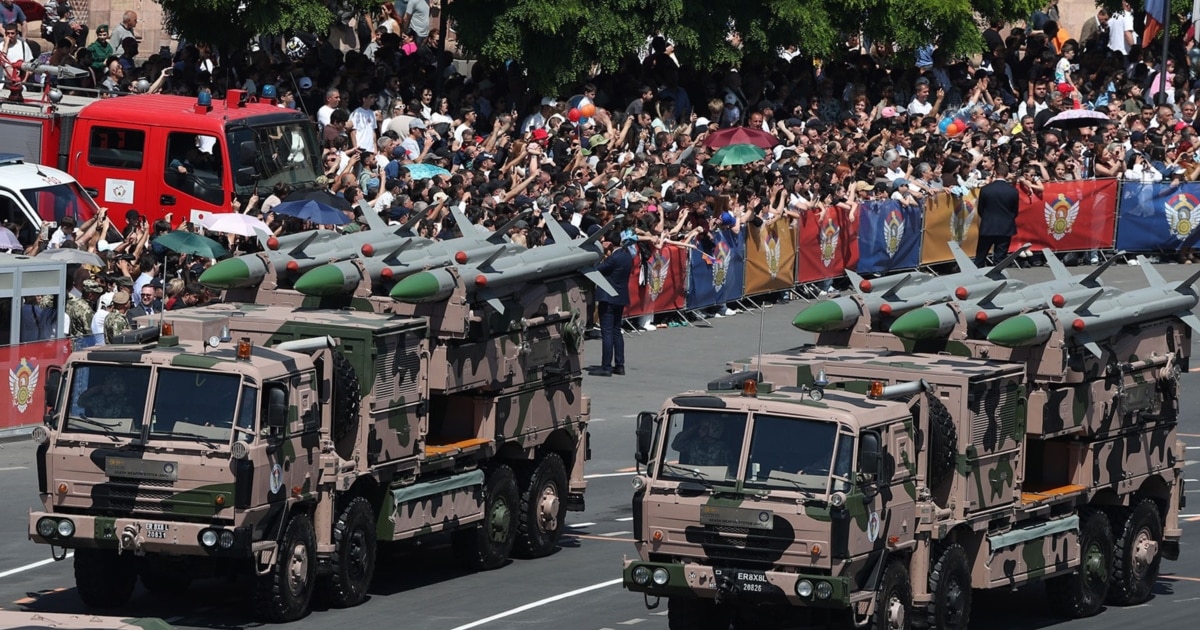
India’s defense sector has marked a significant step in Central Asia, with the successful shipment of its Akash air-defense system to Tajikistan and Turkmenistan. Although the specific details such as the number of systems, delivery timelines, and prices have not been disclosed, this move is seen as a shift away from dependency on Russian military systems, which have historically been prevalent in the region.
Indian Defense Secretary Rajesh Kumar Singh confirmed the shipment last week. Indian media had previously indicated that Armenia placed an order for 15 Akash systems in 2022 valued at around $720 million, although neither government has officially verified this figure. The Akash system is designed to intercept various aerial threats, including aircraft, drones, and missiles.
Soviet-Era Equipment
Central Asia has long relied on Soviet and Russian military equipment, with Moscow providing essential hardware, training, and maintenance services. The Russian-led Collective Security Treaty Organization (CSTO) has solidified Russia’s role as the core security provider in the region. Pavel Baev, a research professor from the Peace Research Institute Oslo, interprets the recent acquisitions as a political gesture aimed at signaling to Moscow that its influence is waning. “This is more about making a point than about real strategic capabilities,” Baev stated.
Tajikistan, a member of the CSTO, hosts a considerable Russian military presence, while Turkmenistan maintains an officially neutral stance. According to Baev, both nations are keen to demonstrate to Moscow that its historical dominance is eroding. In addition to the political implications, practical challenges arise as Western sanctions and ongoing conflict in Ukraine hinder Russia’s ability to supply and maintain military assets.
Data from the Stockholm International Peace Research Institute (SIPRI) indicates that Russian arms exports have plummeted by 64 percent from 2016-20 to 2021-25, diminishing Russia’s share of global arms exports from 21 percent to 6.8 percent.
Despite these declines, Russia continues to engage in arms contracts, with Russia’s First Deputy Prime Minister Denis Manturov reporting in January a record arms-export contract portfolio of $70 billion, surpassing the $55 billion recorded before 2022. However, Kazakh military analyst and retired aviation colonel Yermek Seitbattalov notes that this situation is prompting governments to seek alternative suppliers as the reliability of Russian support diminishes.
Seitbattalov expressed that while new acquisitions, such as the Akash system, may not drastically change the military balance in Central Asia, they address urgent defense needs. Nevertheless, he emphasized that a comprehensive air defense network requires a robust infrastructure, including radars and command-and-control centers, to function effectively.
More Suppliers, More Problems
The diversification of military suppliers in Central Asia brings potential integration challenges. The region’s militaries are increasingly incorporating a mix of systems from Russia, China, Turkey, India, and Western countries, which can lead to compatibility issues. Recent military parades showcased this trend; Turkmenistan exhibited the Chinese FK-2000 air-defense system alongside various Western-produced aircraft, while Tajikistan presented the HQ-17AE air-defense system from China, among other military assets.
While these acquisitions may enhance military capability, Seitbattalov warned that technical discrepancies among these systems can complicate integration into a cohesive defense framework. “These weapons cannot operate on common standards,” he said, highlighting the difficulties of training personnel to manage diverse systems and maintaining effective operational readiness.
As Central Asia looks for reliable alternatives to Russian military support, China stands out as a significant partner. Researcher Baev noted that although China aims to foster stability in the region, it does not seek to dominate, which may lead to a more multipolar arms supply landscape in Central Asia. According to SIPRI, China’s arms exports rose by 11 percent from 2016-20 to 2021-25, predominantly focused on Asia and Oceania.
This evolving military environment in Central Asia signals that the region may no longer rely on a single dominant external supplier. With Russia grappling with supply chain barriers, its commitment to maintaining military relations in Central Asia remains evident. In July, President Putin signed directives to potentially revamp military-technical cooperation agreements with Kazakhstan and Uzbekistan, highlighting ongoing efforts to secure defense ties despite current challenges.
