




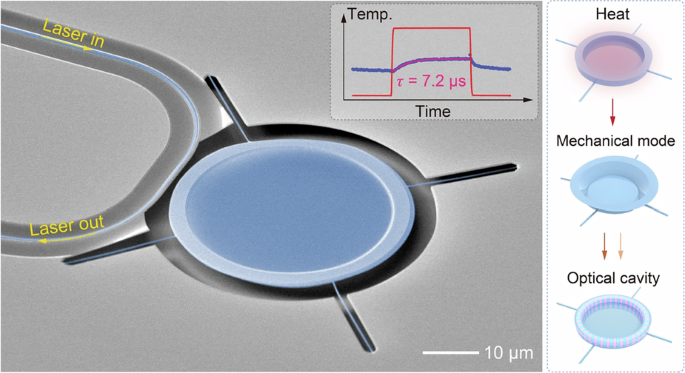
Researchers have developed a low-noise optomechanical sensing platform utilizing thin-film lithium niobate (TFLN), showcasing the potential for rapid and effective temperature and optical power detection. The platform incorporates hundreds of integrated pixels within a compact 1 cm × 1 cm chip, designed to achieve high-quality optical and mechanical resonances essential for minimizing thermal and readout noise.
This new optomechanical system operates on the principles of mechanical displacement coupling with optical fields through mechanisms such as moving-boundary (MB) and photoelastic (PE) effects. The unique properties of lithium niobate provide an additional coupling path via its electro-optic (EO) and piezoelectric effects. This allows for modulating the optical field based on the mechanical displacement, enhancing sensitivity during detection processes.
The optomechanical platform employs radial-mode bowl-shaped resonators fabricated on a 300-nm X-cut LN substrate. These resonators are designed with a thickness that optimizes their mechanical vibrations while maintaining minimal optical losses. The device features a carefully calculated structure that balances optical bending loss with the device’s overall footprint.
Experimental setups revealed that the resonator achieves intrinsic quality factors of 1.6 × 10⁶ pre-suspension, with substantial stability in operational performance even after the fabrication process. The resonator also exhibited high thermal sensitivity, with temperature coefficient values reaching up to −124 ppm K−1 for its fundamental mode, significantly exceeding those of other integrated platforms.
In testing, researchers utilized balanced homodyne detection to measure thermomechanical vibrations, achieving a maximum signal-to-noise ratio of 24 dB. The device demonstrated strong responsivity in detecting optical power, establishing a notable power-to-frequency responsivity of 30 kHz μW-1 in experiments.
To further assess its capabilities, the device’s thermal response was characterized by changing equilibrium temperatures using thermoelectric cooling. Simulations indicated that the design effectively improves thermal response speed while enhancing overall detector performance.
This innovation represents a breakthrough in integrated optomechanical systems, potentially enabling efficient, low-noise sensors for applications in various industries, particularly where continuous monitoring is crucial, including environments that are hazardous or difficult to access. Future developments may focus on integrating broader spectral coverage capabilities directly onto the device, enhancing its operational versatility.
